A Window Into the Universe's Infancy
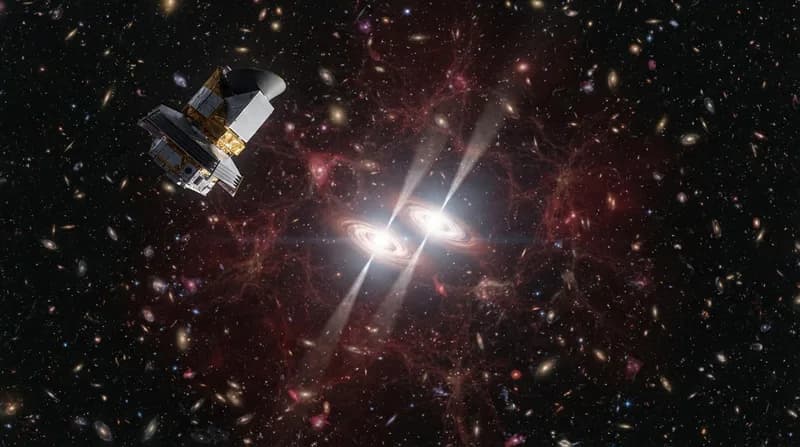
The European Space Agency’s (ESA) Euclid space telescope has made a groundbreaking contribution to astrophysics by identifying 31 ancient quasars, two of which have shattered existing records for the earliest such objects ever observed. These brilliant cosmic beacons date back to a time when the universe was only 670 million years old—merely 5% of its current age. Powered by gargantuan supermassive black holes, these quasars shone with the intensity of a trillion suns, providing scientists with an unprecedented view of the early cosmos.
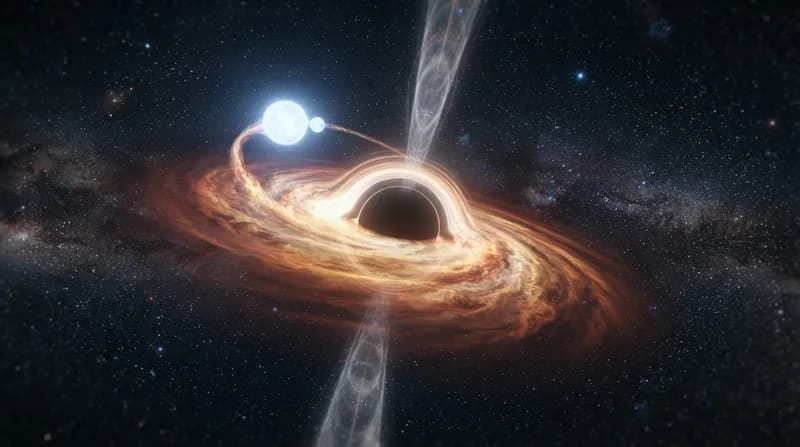
Quasars represent a volatile and brief phase in a galaxy's evolution, occurring when massive amounts of matter spiral into a central black hole. This intense gravitational feeding frenzy releases an extraordinary output of energy, causing the galactic core to outshine all the stars in its host galaxy combined. Because these objects are so rare and faint at such great distances, locating them has historically been a monumental challenge for astronomers.
The Record-Breaking Discoveries
Among the newly cataloged quasars, two stand out as scientific milestones. The most ancient, designated EUCL J172902.75+641018.1, boasts a redshift of 7.77, while its companion, EUCL J125308.55+705432.3, sits at a redshift of 7.69. In the language of cosmology, redshift measures how much light is stretched by the expansion of the universe; a redshift of 7 or higher places these objects firmly within the first 770 million years of cosmic history.
The sheer velocity of these discoveries marks a shift in the field of observational astronomy. Previously, it took researchers more than a decade to identify just ten quasars at this distance. Euclid has surpassed that total in its first year of operation, effectively creating a demographic 'census' of the early universe that was previously impossible to achieve.
Why It Matters: Contextualizing the Cosmic Dawn
The significance of these findings extends far beyond simple record-breaking. These quasars exist within a pivotal epoch known as the 'epoch of reionization,' a time when the universe transitioned from a cold, dark void into the light-filled expanse we see today. By studying the environments around these black holes, researchers are uncovering how the first massive galaxies formed and how supermassive black holes grew to such immense sizes so quickly after the Big Bang.
One of the identified quasars has already yielded deep insights; follow-up investigations suggest it is embedded in a galaxy actively churning out new stars at a high rate. This suggests a symbiotic evolutionary relationship between early supermassive black holes and their host galaxies, offering a roadmap for how the largest structures in the universe first took shape.
Unrivaled Capabilities of the Euclid Telescope
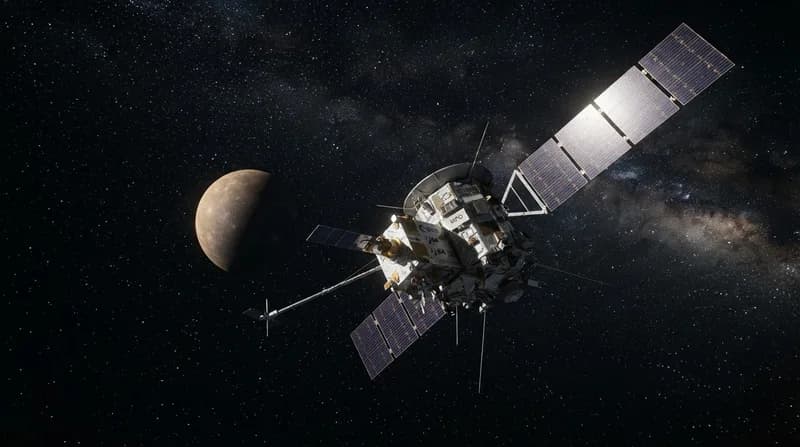
Euclid’s success is a direct result of its specialized design. While many telescopes are optimized for deep, narrow fields of view, Euclid is designed to map vast swaths of the sky while maintaining high-resolution, infrared sensitivity. This combination allows it to scan for rare, faint sources that are invisible to ground-based observatories.
Supported by a global consortium of thousands of scientists and engineers, the Euclid Wide Survey is currently tasked with mapping over one-third of the entire sky. As the survey continues, the growing collection of distant quasars will continue to serve as 'time machines,' allowing astronomers to peer back into the very foundation of cosmic structure and solve the persistent mysteries surrounding the growth of black holes in the infant universe.