ScienceTechnical Deep Dive

Cracking the Barium Titanate Code: A Quantum Leap for Optical Networking

Published
EElectricBuzz Editorial Team
Cracking the Barium Titanate Code: A Quantum Leap for Optical Networking
3 min read469 wordsElectricBuzz Editorial Team

The Gist

“A joint research team has finally decoded the complex optical properties of barium titanate, clearing the path for faster, more efficient data transmission.”

A New Foundation for Photonic Speed

For decades, the field of optical communications has faced a persistent hurdle: the mysterious and inconsistent nature of barium titanate (BTO). While this material has long been recognized as a powerhouse for light manipulation, its complex internal crystalline structure made it notoriously difficult to measure. Now, a breakthrough collaboration between KAIST and Caltech has finally resolved these uncertainties, providing the scientific community with a precise roadmap for integrating BTO into the next generation of high-speed data transmission technology.

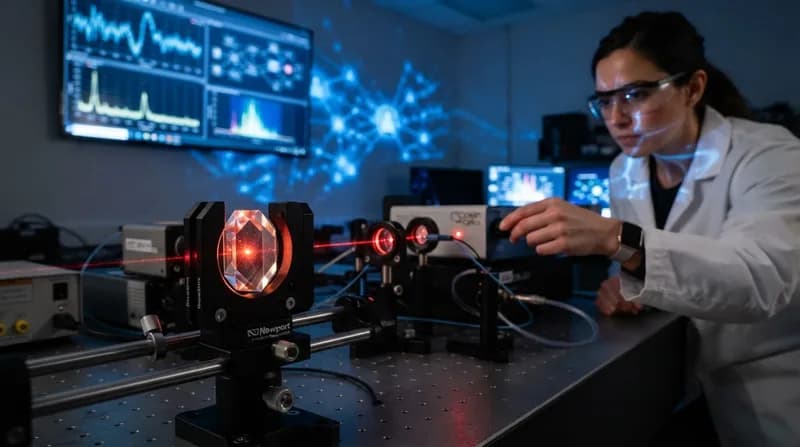
The study, published in ACS Photonics, utilized advanced Mueller matrix spectroscopic ellipsometry to map how BTO interacts with light across an immense range, from ultraviolet to far-infrared wavelengths. By isolating single-crystal samples with consistent domain orientations, the researchers were able to strip away the noise that led to decades of conflicting data. The result is a highly accurate set of measurements for BTO’s refractive index and extinction coefficient, two vital metrics for engineers designing optical waveguides and modulators.

Why It Matters: The Pockels Effect and Data Throughput

At the heart of the excitement surrounding BTO is the Pockels effect—the material's unique ability to alter its optical response when subjected to an electric field. This property makes BTO an ideal candidate for optical modulators, the critical components that translate electrical signals into light-based data streams. Until now, the lack of reliable data on how light loss occurs within BTO meant that engineers were largely guessing when designing complex photonic circuits.

By quantifying these properties with extreme precision, the research team has unlocked several key capabilities for future infrastructure:

  • Reduced Signal Loss: With accurate extinction coefficients—down to 10^-5 in the 2-10 micrometer range—engineers can now model and minimize light absorption within components, leading to cleaner signal integrity over longer distances.
  • Faster Prototyping: Precise material modeling replaces trial-and-error manufacturing, allowing designers to simulate circuit performance before a single physical component is forged.
  • Quantum Integration: The ability to manipulate light with this level of accuracy is a prerequisite for emerging quantum photonic circuits, which require extreme precision to process quantum information.

A Pathway to Next-Gen Infrastructure

The implications of this study reach far beyond traditional fiber-optic internet. As we transition toward architectures that rely on light to move information at every stage of the computing process, the need for stable, predictable optical materials has never been higher. The team's development of a new predictive method for crystals with multiple domains ensures that this research is not just theoretical; it provides a practical framework for real-world manufacturing.

Moving forward, the ability to control light with such finesse will be essential for miniaturizing components while simultaneously boosting bandwidth. By solving this "decades-old mystery," researchers have provided the missing puzzle piece required to scale up photonic technologies, promising a future where data travels faster, more reliably, and with significantly less energy waste.


SPONSORED
The 5 Best Over-Ear ANC Headphones of 2026, Tested & Ranked
Editor's Pick Guide
92/100
Tech & Gadgets•12 min read

The 5 Best Over-Ear ANC Headphones of 2026, Tested & Ranked

We locked five over-ear ANC picks for 2026 — Sony WH-1000XM6, Bose QuietComfort Ultra 2, Soundcore Space One, Sennheiser Momentum 5, and Apple AirPods Max 2 — then stress-tested them on lab metrics, long-term owner truth, and live street prices.

Related Stories

Semantically matched articles, ranked by topic overlap and freshness.

Crafting the 'Unicorn Career': Navigating Professional Uncertainty in the Age of AI
Science

Crafting the 'Unicorn Career': Navigating Professional Uncertainty in the Age of AI

STEM career expert Alaina G. Levine breaks down how to design a deeply personal, value-aligned career trajectory in a rapidly shifting technological landscape.

BepiColombo’s X-Ray Vision: A Deep-Space Triumph Eight Years in the Making
Science

BepiColombo’s X-Ray Vision: A Deep-Space Triumph Eight Years in the Making

After an eight-year journey spanning 10 billion kilometers, the BepiColombo mission has successfully activated its groundbreaking X-ray telescope, signaling a new era for planetary exploration.

A Day in the Void: Voyager 1 Reaches Historic One-Light-Day Milestone
Science

A Day in the Void: Voyager 1 Reaches Historic One-Light-Day Milestone

NASA's legendary Voyager 1 probe has officially crossed the one-light-day threshold, marking a new chapter in the farthest-reaching human endeavor in history.

Breakthrough 'Molecular Glue' Offers New Hope for RAS-Driven Cancers
Science

Breakthrough 'Molecular Glue' Offers New Hope for RAS-Driven Cancers

A novel therapeutic, ERAS-0015, is showing remarkable promise in clinical trials for treating aggressive, hard-to-target lung and pancreatic cancers.

The Hidden Chemical Threat: How Microplastics Interact with Water to Damage Cells
Science

The Hidden Chemical Threat: How Microplastics Interact with Water to Damage Cells

A groundbreaking study from Columbia University reveals that microplastics are not just inert physical intruders; they actively trigger dangerous chemical reactions within the human body.

Stellar Collision Course: The Hidden Engines Feeding Sagittarius A*
Science

Stellar Collision Course: The Hidden Engines Feeding Sagittarius A*

Astronomers have uncovered a cosmic food chain in the heart of our galaxy, linking a powerful binary star system to the steady fuel supply of the Milky Way's supermassive black hole.

Mapping the Genetic Blueprint of Immune Aging
Science

Mapping the Genetic Blueprint of Immune Aging

Researchers at Monash University have mapped the genetic mechanisms behind immune system decline, offering new hope for targeted cancer and infection therapies.

Ketogenic Diet Outperforms Other Methods in Rapid Liver Fat Reduction
Science

Ketogenic Diet Outperforms Other Methods in Rapid Liver Fat Reduction

A new clinical trial reveals that a ketogenic diet significantly outperforms Mediterranean and low-fat protocols in reducing liver fat and reversing prediabetes, independent of total weight loss.