The Cosmic Gastronomy of the Galactic Center
For years, the chaotic environment surrounding Sagittarius A*—the supermassive black hole at the heart of the Milky Way—has baffled astrophysicists. While the region is teeming with gas, dust, and stars, determining exactly what feeds the massive gravitational sinkhole has remained a significant challenge. New research from an international team led by the Max Planck Institute for Extraterrestrial Physics (MPE) now suggests that the "diet" of our galaxy's central black hole is being managed by a surprisingly localized source: a pair of massive stars locked in a violent, high-speed dance.
By utilizing advanced infrared spectrographs known as SINFONI and ERIS, researchers have traced the origins of mysterious gas clouds that have long been observed orbiting the galactic center. These clouds, which include the well-documented G1 and G2 entities, were once thought to be independent phenomena. However, updated analysis suggests they are actually part of a continuous, coherent stream of material originating from a single point of origin.
The Role of the IRS 16SW Binary System
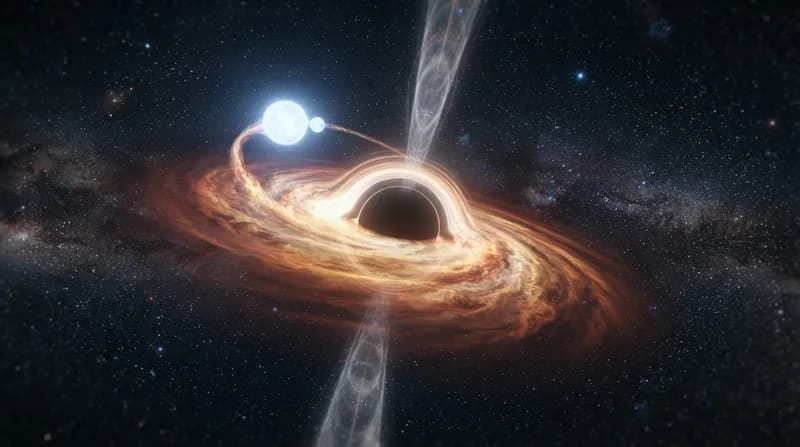
The investigation pointed to a specific, high-energy culprit: IRS 16SW. This object is a massive contact binary system—two gargantuan stars situated in such proximity that they are essentially touching. As these two stellar behemoths orbit one another, their intense, high-velocity solar winds collide with the surrounding interstellar environment. This collision creates a localized shockwave, compressing ambient gas into dense, compact clumps.
These compressed clumps do not simply dissipate. Instead, they are ejected from the binary system and pulled into the gravitational well of Sagittarius A*. As the material travels along an elongated, shared orbit, it appears to observers as distinct clouds—G1, G2, and their companions—forming a cohesive stream of "fuel" that the black hole steadily consumes. Computer simulations have confirmed that the orbital characteristics of these clouds align perfectly with the movement of the IRS 16SW system, providing a robust physical explanation for a phenomenon that has puzzled astronomers for decades.
Why It Matters
- Fueling the Giant: Calculations suggest that the accretion of approximately one Earth-mass of gas every decade is sufficient to maintain the current activity levels of Sagittarius A*.
- Stellar Connection: This discovery illustrates a vital feedback loop where the life cycle of massive stars directly influences the growth and long-term sustainability of supermassive black holes.
- Technological Precision: The study highlights the power of adaptive optics and infrared spectroscopy in cutting through the dense dust of the Galactic Center, allowing scientists to reconstruct 3D trajectories of matter in real-time.
Implications for Galactic Evolution
This finding marks a major shift in how we understand the "nourishment" of supermassive black holes. Previously, researchers focused on external material or larger-scale processes to explain how these giants maintain their activity. Now, it appears that the stellar neighborhood plays a much more proactive role than once thought. By identifying the specific mechanism through which binary stars produce these gas clouds, scientists have opened a new window into the complex interplay between stellar evolution and the most extreme objects in the universe. This research not only clarifies the history of the G1-2-3 streamer but also provides a template for studying how other galaxies might feed their own central black holes through the winds of local, massive star systems.