The Evolution of Scintillation Technology
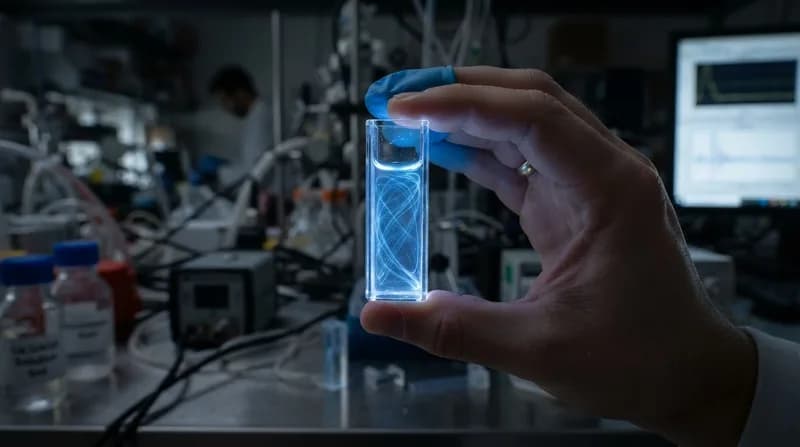
For decades, the field of radiation detection has relied heavily on complex, expensive crystalline materials to convert ionizing radiation into visible light. While these crystals offer high light yields, their prohibitive manufacturing costs and structural limitations have long held back broader applications. A research team led by the Institute of High Energy Physics at the Chinese Academy of Sciences has introduced a potential paradigm shift: a new cerium-doped gadolinium-rich glass scintillator that combines affordability with multi-modal detection capabilities.
This innovative material is designed to detect X-rays, gamma rays, neutrons, and high-energy particles like muons and pions with impressive efficiency. By leveraging a unique borosilicate scaffold, the researchers have managed to overcome the traditional trade-offs between material density—which is critical for radiation absorption—and scintillation performance, which determines how much detectable light is produced after the energy is captured.
The Science Behind the Breakthrough
The core of this advancement lies in the material's refined composition. By incorporating gadolinium (III) fluoride into a gadolinium-rich glass matrix, the team created a structure with reduced rigidity. This modification allows for a significantly higher concentration of rare-earth ions, which are essential for absorbing incoming radiation. The fluoride ions play a dual role: they lower the phonon energy, which suppresses non-radiative energy loss, and they create a local environment that enhances the probability of radiative transition, effectively turning more absorbed energy into usable light.
Spectroscopic analysis confirmed that the gadolinium ions cluster in a mixed oxygen-fluorine environment. This specific structural arrangement acts as an energy relay, transferring absorbed radiation to the cerium dopant ions with an efficiency of 85.5%. This high transfer efficiency is what allows the glass to produce the robust light signals required for demanding tasks, such as those found in hadronic calorimeters for high-energy particle physics experiments.
Potential Applications and Future Outlook
The versatility of this glass scintillator opens doors across several high-stakes industries. Beyond the particle accelerators where researchers measure the energy of strongly interacting particles, the material shows promise in medical imaging. During testing, the glass achieved a spatial resolution of 29.8 lp/mm, a metric that rivals the sharpest glass scintillators currently documented. This level of clarity suggests that future mammography systems could become both more accurate and more patient-friendly, as glass is inherently easier to mold into specific, comfortable geometries compared to rigid, fragile crystals.
- Enhanced Density: High concentration of rare-earth atoms ensures superior radiation capture.
- Multi-Modal Detection: Capable of sensing X-rays, gamma rays, neutrons, and high-energy beams.
- Improved Efficiency: 85.5% energy transfer rate to cerium dopants.
- Scalability: Low-cost manufacturing processes make it a viable alternative to synthetic crystals.
As the scientific community continues to push the boundaries of dark matter research and industrial monitoring, the transition from expensive crystals to adaptable, cost-effective glass could democratize access to high-precision radiation detection. The success of this cerium-doped gadolinium oxyfluoride glass marks a significant step forward in material science, bridging the gap between theoretical potential and practical, large-scale utility.