A Bizarre Evolutionary Twist
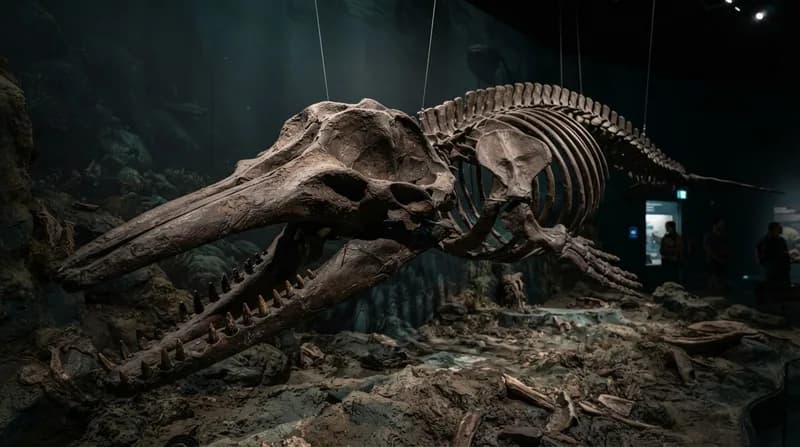
In the sun-baked desert of Peru’s Pisco Formation, scientists have unearthed a fossil that seems to have been carved by an artist with a penchant for the absurd. The extinct pygmy sperm whale, formally named Scaphokogia huachafo, roamed the oceans roughly 6 million years ago during the Late Miocene. While toothed whales are known for their somewhat unusual cranial structures—often adapted for complex echolocation—this specific specimen features a level of facial asymmetry that is unprecedented in the history of mammals.
For years, researchers were stumped by the skull’s jarring, uneven architecture. When it was first recovered in the mid-1990s, experts debated whether the dramatic distortion was a result of millions of years of geological pressure or a genuine biological trait. However, recent analysis has confirmed the latter. There are no fractures or pathological deformations present; the skull is perfectly preserved in its original, chaotic configuration. Lead researcher Aldo Benites-Palomino describes the discovery as one that broke every rule of symmetry found in modern cetaceans, leading the team to adopt the Peruvian slang term huachafo—meaning flashy, bizarre, or extravagant—as its official scientific name.
An Anatomical Marvel for the Seafloor
The bizarre appearance of Scaphokogia huachafo was far from a random mutation; it was a highly specialized adaptation for a unique survival strategy. Unlike modern sperm whales that plunge into the abyss to hunt squid, this ancient creature was a master of the shallow coast. Its most defining feature was a downward-curving, reinforced snout composed of dense bone and cartilage, which acted as a physical ballast to shift the animal's center of gravity forward and downward.
The modifications extended deep into the creature's physiology. The researchers discovered that the joint connecting the skull to the neck could allow the whale to angle its head downward by as much as 55 degrees. This, combined with the extreme facial shift, allowed the whale to hover over the seabed and scan for prey buried in the sediment. Without the benefit of sensitive whiskers, the whale likely utilized its highly asymmetrical skull to house a sophisticated biological sonar, enabling it to detect hidden marine life in murky coastal waters.
Why it Matters
- Rewriting Evolutionary History: The discovery proves that mammalian anatomy can diverge into extreme, highly specialized forms that prioritize function over aesthetic symmetry.
- Benthic Specialization: This whale represents a lost niche in marine biology, showcasing an extinct method of bottom-feeding that differs significantly from current ocean inhabitants.
- Taphonomic Clarity: The study serves as a masterclass in distinguishing between fossil damage (taphonomy) and legitimate evolutionary adaptation, settling a long-standing debate within the paleontological community.
An Extinct Legacy
The ecological niche occupied by Scaphokogia huachafo was short-lived. As the ocean conditions of the Miocene began to shift, the coastal environments that supported this bottom-feeding specialist vanished, eventually leading to the species' extinction. Today, this whale stands as a testament to the sheer variety of life that has occupied the planet. It remains a fascinating reminder that in the high-stakes theater of natural selection, being “bizarre” is often just another word for being highly efficient. The huachafo whale did not just survive; it thrived in an environment that no other mammal could exploit, leaving behind a skull that continues to baffle and inspire scientists today.