The One-Light-Day Milestone
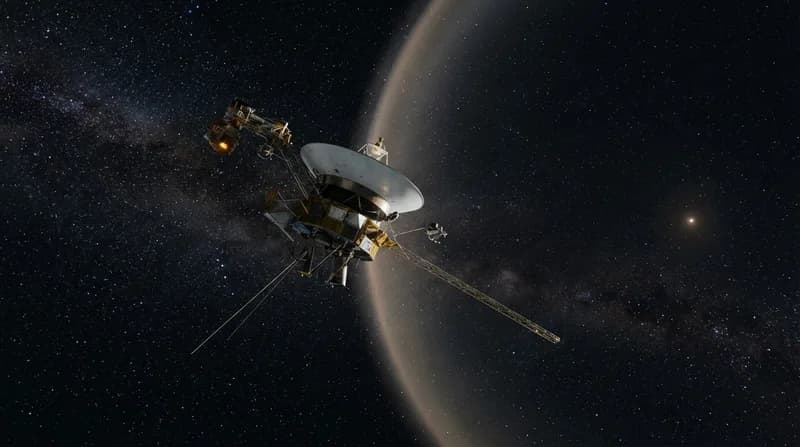
In a feat of endurance that defies nearly half a century of spaceflight norms, NASA’s Voyager 1 has officially crossed the distance of one light-day from Earth. On November 18, 2026, the venerable spacecraft reached approximately 16.1 billion miles away from its home planet. At this extreme range, radio signals traveling at the speed of light now require a full 24 hours to bridge the gap between the probe and mission control at the Jet Propulsion Laboratory.
This milestone is not merely a numerical achievement; it highlights the profound solitude of a mission launched in 1977. While sunlight reaches our Moon in roughly 1.3 seconds, the signals guiding Voyager 1 must traverse the vast expanse of the outer solar system and into the interstellar medium, with a complete round-trip communication exchange now taking two full days.
Engineering Against Entropy
Operating a piece of hardware built nearly 50 years ago requires a constant, inventive battle against degradation. Voyager 1 draws its power from a radioisotope thermal generator—essentially a nuclear battery—that loses approximately four watts of electrical output annually as its plutonium source decays. To keep the mission alive, NASA engineers have been forced to systematically power down non-essential systems and swap out aging instrument protocols for more efficient alternatives.
Despite these mounting technical hurdles, the probe remains a vital scientific asset. It currently monitors conditions in the interstellar medium, providing humanity with its only direct observations from beyond the heliosphere—the protective bubble created by our Sun. Even with recent data transmission interruptions, the continued presence of a carrier signal confirms that the spacecraft is still functioning and traversing the unknown regions of the galaxy.
Why It Matters
- Interstellar Insights: Voyager 1 provides data on the Sun’s influence on interstellar space that cannot be replicated by any other mission.
- Longevity Record: The mission serves as the ultimate test of long-term space hardware reliability.
- Cultural Legacy: The onboard Golden Record remains an enduring message to the cosmos, preserving human culture long after electrical power eventually fails.
The Final Ambassador
The mission has evolved significantly from its original "Grand Tour" of Jupiter, Saturn, Uranus, and Neptune. Today, it serves as a sentinel of human curiosity. While mission managers continue to send weekly commands and receive daily updates, they acknowledge that the probe is approaching a inevitable, silent phase. Even when the power finally fades and the ability to communicate with Earth is lost, the spacecraft will continue its trajectory as an silent ambassador of humanity, carrying the Golden Record deep into the stars.
NASA’s ability to keep the probe operational until at least its 50th launch anniversary in 2027 is a testament to the original engineering teams and the current generation of scientists at JPL. As it drifts further into the pristine interstellar void, Voyager 1 remains a living monument to human exploration and the relentless drive to push beyond the boundaries of the known universe.