ScienceTechnical Deep Dive

Unlocking Silence: The Next Frontier of Brain-Computer Interfaces

Published
EElectricBuzz Editorial Team
Unlocking Silence: The Next Frontier of Brain-Computer Interfaces
3 min read418 wordsElectricBuzz Editorial Team

The Gist

“Recent breakthroughs unveiled at Neuroscience 2026 are transforming how we translate neural activity into human communication for those with paralysis.”

Revolutionizing Communication via Neural Decoding

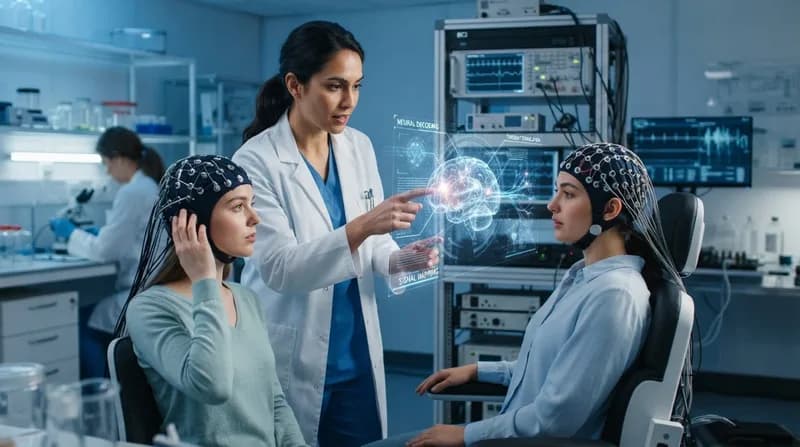
The field of brain-computer interfaces (BCIs) is experiencing a period of rapid evolution, moving from the realm of speculative research into tangible, life-changing applications for individuals suffering from paralysis. At the recent Neuroscience 2026 conference, researchers highlighted how modern hardware is bridging the gap between locked-in neurological states and the outside world by translating raw brain signals into functional, human-like output.

These systems utilize high-precision sensors to record cortical electrical activity, feeding this data into sophisticated algorithms that interpret intent. As the global market for BCI technology tracks toward a multi-billion dollar valuation by 2030, these devices are transitioning from bulky lab equipment into efficient, portable tools designed for daily independence.

Expressive Synthetic Speech

Researchers at the University of California, Davis, have made a significant leap in the quality of BCI-generated audio. By focusing on pitch variation, their latest system allows users to move beyond monotone computer-generated voices, facilitating expressive speech that carries human cadence and emotion. This breakthrough is not merely functional; it enables patients to engage in nuanced communication and even participate in musical activities like singing, significantly improving the social experience for those with severe speech impairments.

Independent Communication in Locked-in States

Clinical progress led by Massachusetts General Hospital is tackling one of the most difficult challenges in neurology: the "completely locked-in" state. New data presented by the team demonstrates a patient successfully maintaining independent communication for over a year using a BCI that decodes intended movement patterns directly from brain signals. By focusing on the intent to move, the system provides a reliable, persistent conduit for expression, bypassing the physical inability to speak or interact with external interfaces.

Portable Neural Translation

Perhaps the most significant step toward mainstream accessibility is the development of portable, high-performance decoding platforms. A joint project between the Georgia Institute of Technology and Emory University has successfully demonstrated a BCI system capable of converting brain activity into text with high accuracy on mobile hardware, such as an iPhone. This shift toward mobile-compatible, reliable, and efficient decoding represents a critical bridge, ensuring that life-changing technology is not tethered to a clinic and can eventually reach the home environment.

Why it Matters

  • Independence: Restores autonomy for individuals with ALS, stroke, and other neurological conditions.
  • Market Growth: The shift from $1.7 billion in 2022 to an estimated $6.2 billion by 2030 indicates a massive influx of investment and engineering focus.
  • Accessibility: The transition to portable and mobile-integrated systems marks the beginning of consumer-level usability for medical-grade assistive hardware.

SPONSORED
The 5 Best Over-Ear ANC Headphones of 2026, Tested & Ranked
Editor's Pick Guide
92/100
Tech & Gadgets•12 min read

The 5 Best Over-Ear ANC Headphones of 2026, Tested & Ranked

We locked five over-ear ANC picks for 2026 — Sony WH-1000XM6, Bose QuietComfort Ultra 2, Soundcore Space One, Sennheiser Momentum 5, and Apple AirPods Max 2 — then stress-tested them on lab metrics, long-term owner truth, and live street prices.

Related Stories

Semantically matched articles, ranked by topic overlap and freshness.

Crafting the 'Unicorn Career': Navigating Professional Uncertainty in the Age of AI
Science

Crafting the 'Unicorn Career': Navigating Professional Uncertainty in the Age of AI

STEM career expert Alaina G. Levine breaks down how to design a deeply personal, value-aligned career trajectory in a rapidly shifting technological landscape.

Cracking the Barium Titanate Code: A Quantum Leap for Optical Networking
Science

Cracking the Barium Titanate Code: A Quantum Leap for Optical Networking

A joint research team has finally decoded the complex optical properties of barium titanate, clearing the path for faster, more efficient data transmission.

BepiColombo’s X-Ray Vision: A Deep-Space Triumph Eight Years in the Making
Science

BepiColombo’s X-Ray Vision: A Deep-Space Triumph Eight Years in the Making

After an eight-year journey spanning 10 billion kilometers, the BepiColombo mission has successfully activated its groundbreaking X-ray telescope, signaling a new era for planetary exploration.

A Day in the Void: Voyager 1 Reaches Historic One-Light-Day Milestone
Science

A Day in the Void: Voyager 1 Reaches Historic One-Light-Day Milestone

NASA's legendary Voyager 1 probe has officially crossed the one-light-day threshold, marking a new chapter in the farthest-reaching human endeavor in history.

Breakthrough 'Molecular Glue' Offers New Hope for RAS-Driven Cancers
Science

Breakthrough 'Molecular Glue' Offers New Hope for RAS-Driven Cancers

A novel therapeutic, ERAS-0015, is showing remarkable promise in clinical trials for treating aggressive, hard-to-target lung and pancreatic cancers.

The Hidden Chemical Threat: How Microplastics Interact with Water to Damage Cells
Science

The Hidden Chemical Threat: How Microplastics Interact with Water to Damage Cells

A groundbreaking study from Columbia University reveals that microplastics are not just inert physical intruders; they actively trigger dangerous chemical reactions within the human body.

Stellar Collision Course: The Hidden Engines Feeding Sagittarius A*
Science

Stellar Collision Course: The Hidden Engines Feeding Sagittarius A*

Astronomers have uncovered a cosmic food chain in the heart of our galaxy, linking a powerful binary star system to the steady fuel supply of the Milky Way's supermassive black hole.

Mapping the Genetic Blueprint of Immune Aging
Science

Mapping the Genetic Blueprint of Immune Aging

Researchers at Monash University have mapped the genetic mechanisms behind immune system decline, offering new hope for targeted cancer and infection therapies.