ScienceTechnical Deep Dive

Quantum Leap: Laser Light Reveals Hidden Secrets of 'Polar Nanoregions'

Published
EElectricBuzz Editorial Team
Quantum Leap: Laser Light Reveals Hidden Secrets of 'Polar Nanoregions'
3 min read445 wordsElectricBuzz Editorial Team

The Gist

“Physicists have successfully used ultra-fast laser pulses to manipulate internal electrical patterns within crystals, potentially paving the way for next-generation, high-speed computing.”

Unlocking the Subatomic Mystery

For decades, researchers have been perplexed by the behavior of certain quantum materials, specifically modified versions of strontium titanate. This crystal is unique because it allows electrons to travel through it while simultaneously containing microscopic electrical zones known as polar nanoregions. These tiny "islands" possess positive and negative poles, and determining whether these regions form spontaneously or exist pre-configured—like a crowd of people turning in unison—has remained an elusive goal in solid-state physics.

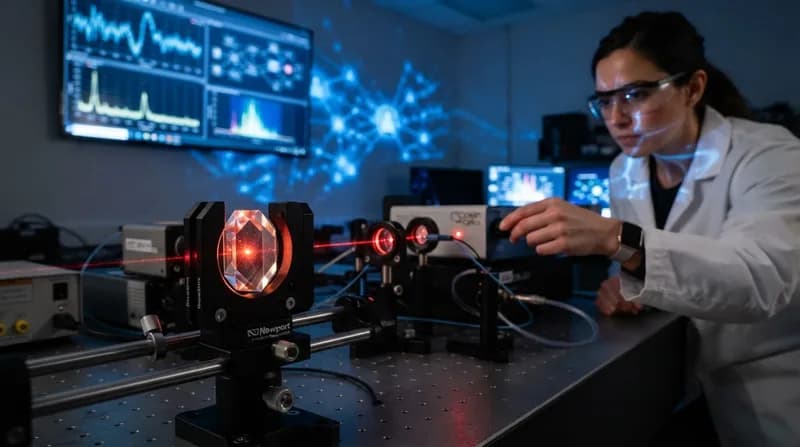
A research team led by Wencan Jin and Mohamed Kandil at Auburn University has finally provided an answer. By developing a highly sensitive optical measurement system, the team was able to monitor these microscopic regions as they cooled. Their observations confirmed that these polar nanoregions already exist within the crystal structure; as the temperature drops, they simply transition from random orientations to a state of organized alignment. This discovery effectively settles a long-standing debate regarding the order-disorder phase transition in quantum ferroelectric metals.

Controlling Matter with Light

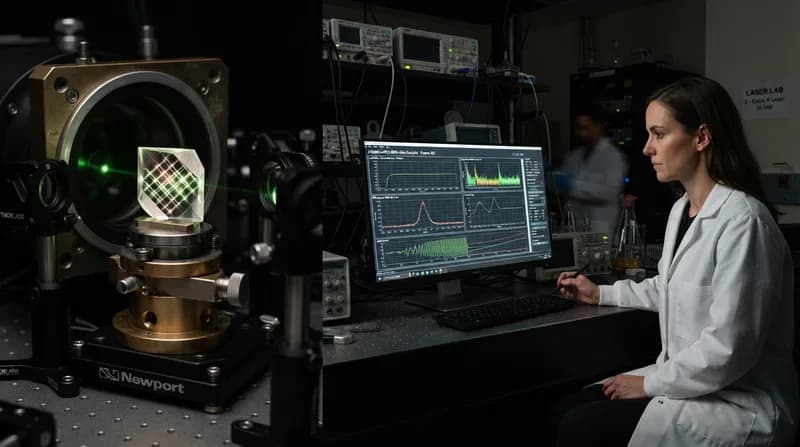
The research team did not stop at observation. Using high-intensity, short-duration laser pulses, they demonstrated the ability to force these microscopic electrical islands into alignment, even at higher temperatures where they would typically be scattered and disorganized. This optical "poling" effect occurs in the blink of an eye—or more accurately, in just one picosecond, or one trillionth of a second.

This mastery over the crystal's internal state represents a significant technical achievement. Achieving such precise control required three years of experimental refinement, starting with the acquisition of specialized crystals from Japan's National Institute of Advanced Industrial Science and Technology and ending with the development of a detection system capable of registering extremely weak optical signals. The successful visualization of these signals marks a major milestone in quantum materials science.

Why it Matters: Implications for Future Tech

  • Ultrafast Computing: The ability to manipulate electrical domains at the picosecond scale suggests potential for computing architectures that operate significantly faster than current silicon-based processors.
  • Data Storage: Because the alignment of these nanoregions can be triggered and detected using light, this mechanism could lead to new, high-density, and ultra-fast non-volatile storage solutions.
  • Quantum Research: This methodology provides a new lens through which scientists can observe and influence quantum materials, accelerating our understanding of condensed matter physics and material design.

While the transition from experimental physics to commercial hardware remains in the future, the ability to "write" information patterns into a crystal using laser light is a foundational step toward entirely new classes of technology. By bridging the gap between fundamental research and optical manipulation, the Auburn University team has opened a doorway to materials that can be reconfigured in real-time at the speed of light.


SPONSORED
The 5 Best Over-Ear ANC Headphones of 2026, Tested & Ranked
Editor's Pick Guide
92/100
Tech & Gadgets•12 min read

The 5 Best Over-Ear ANC Headphones of 2026, Tested & Ranked

We locked five over-ear ANC picks for 2026 — Sony WH-1000XM6, Bose QuietComfort Ultra 2, Soundcore Space One, Sennheiser Momentum 5, and Apple AirPods Max 2 — then stress-tested them on lab metrics, long-term owner truth, and live street prices.

Related Stories

Semantically matched articles, ranked by topic overlap and freshness.

Crafting the 'Unicorn Career': Navigating Professional Uncertainty in the Age of AI
Science

Crafting the 'Unicorn Career': Navigating Professional Uncertainty in the Age of AI

STEM career expert Alaina G. Levine breaks down how to design a deeply personal, value-aligned career trajectory in a rapidly shifting technological landscape.

Cracking the Barium Titanate Code: A Quantum Leap for Optical Networking
Science

Cracking the Barium Titanate Code: A Quantum Leap for Optical Networking

A joint research team has finally decoded the complex optical properties of barium titanate, clearing the path for faster, more efficient data transmission.

BepiColombo’s X-Ray Vision: A Deep-Space Triumph Eight Years in the Making
Science

BepiColombo’s X-Ray Vision: A Deep-Space Triumph Eight Years in the Making

After an eight-year journey spanning 10 billion kilometers, the BepiColombo mission has successfully activated its groundbreaking X-ray telescope, signaling a new era for planetary exploration.

A Day in the Void: Voyager 1 Reaches Historic One-Light-Day Milestone
Science

A Day in the Void: Voyager 1 Reaches Historic One-Light-Day Milestone

NASA's legendary Voyager 1 probe has officially crossed the one-light-day threshold, marking a new chapter in the farthest-reaching human endeavor in history.

Breakthrough 'Molecular Glue' Offers New Hope for RAS-Driven Cancers
Science

Breakthrough 'Molecular Glue' Offers New Hope for RAS-Driven Cancers

A novel therapeutic, ERAS-0015, is showing remarkable promise in clinical trials for treating aggressive, hard-to-target lung and pancreatic cancers.

The Hidden Chemical Threat: How Microplastics Interact with Water to Damage Cells
Science

The Hidden Chemical Threat: How Microplastics Interact with Water to Damage Cells

A groundbreaking study from Columbia University reveals that microplastics are not just inert physical intruders; they actively trigger dangerous chemical reactions within the human body.

Stellar Collision Course: The Hidden Engines Feeding Sagittarius A*
Science

Stellar Collision Course: The Hidden Engines Feeding Sagittarius A*

Astronomers have uncovered a cosmic food chain in the heart of our galaxy, linking a powerful binary star system to the steady fuel supply of the Milky Way's supermassive black hole.

Mapping the Genetic Blueprint of Immune Aging
Science

Mapping the Genetic Blueprint of Immune Aging

Researchers at Monash University have mapped the genetic mechanisms behind immune system decline, offering new hope for targeted cancer and infection therapies.