A New Resident in the Outer Reaches
In a monumental development for planetary science, astronomers have identified a gargantuan, icy body lurking in the dark, crowded regions beyond Pluto. Temporarily designated 2026 ED138, this celestial object has captured the scientific community's attention as a potential candidate for the solar system's sixth officially recognized dwarf planet. If confirmed by further study, it would join the prestigious ranks of Pluto, Ceres, Eris, Haumea, and Makemake, offering researchers a fresh window into the chaotic history of our solar system's formation.
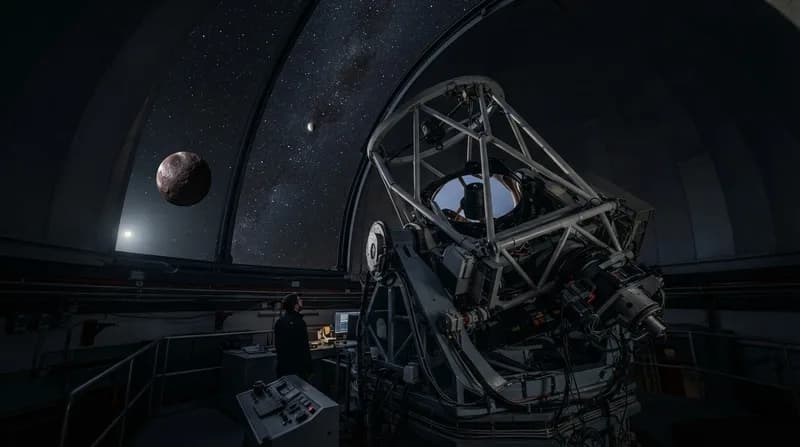
The discovery was made possible by the powerful Simonyi Survey Telescope at the NSF-DOE Vera C. Rubin Observatory. By leveraging advanced computer algorithms, researchers were able to sift through billions of points of light to identify the slow, consistent movement of this distant traveler against the backdrop of the Milky Way. This finding is particularly notable for its rarity; experts estimate that identifying an object of this magnitude—roughly 1,000 kilometers in diameter—occurs only once in a generation.
The Technological Edge: Rubin Observatory
The successful detection of 2026 ED138 highlights the transformative capabilities of the Rubin Observatory. The region where this object resides is notoriously difficult to survey due to the intense density of background stars, which typically masks the faint signature of distant trans-Neptunian objects (TNOs). The observatory’s ability to combine high-speed, repeated sky coverage with sophisticated data-mining software allowed scientists to not only find the object in 2026 data but to "precover" it in historical imagery dating back nearly a decade.
This "precovery" technique is essential for orbital mechanics. By analyzing light signatures from years past, researchers have been able to reconstruct over a decade of the object's path, providing a high degree of confidence in the finding. This capability positions the Rubin Observatory as a primary engine for solar system exploration, promising that 2026 ED138 is likely just the first of many such discoveries as the facility continues its decade-long Legacy Survey of Space and Time.
Why it Matters: Decoding Solar System History
- Orbital Clues: Trans-Neptunian objects act as frozen time capsules. Their compositions and paths reveal how giant planets like Neptune migrated during the early stages of our solar system.
- Dwarf Planet Criteria: The primary requirement for dwarf planet status is sufficient mass to reach hydrostatic equilibrium, resulting in a rounded shape. With estimated dimensions between 600 and 1,500 kilometers, ED138 sits firmly in the range where gravity typically forces this spherical geometry.
- Survey Efficiency: The ability to automate the identification of TNOs allows astronomers to map the outer solar system with unprecedented accuracy, moving beyond localized searches to systemic wide-field monitoring.
As the international astronomical community awaits further validation, 2026 ED138 serves as a vivid reminder of how much remains hidden in the vast, cold periphery of our celestial neighborhood. With the Rubin Observatory fully operational, the coming years are expected to yield a treasure trove of data on these mysterious, icy worlds, potentially rewriting our understanding of the outer solar system's architecture.