The Incredible Journey of the Bogong Moth
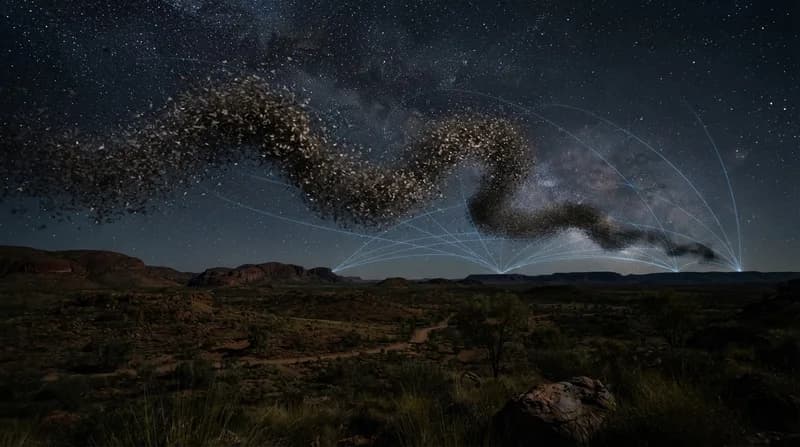
For decades, scientists have been captivated by the migration of the Australian Bogong moth, Agrotis infusa. Every summer, millions of these modest, dark-brown insects embark on a massive nocturnal voyage, traveling over 1,000 kilometers from their breeding grounds to the cool, high-altitude caves of the Snowy Mountains. What makes this journey truly extraordinary is that the moths complete it without ever having been to the destination before, lacking any living guide to show them the path. When autumn rolls around, they return home to mate and conclude their life cycle.
Previous studies identified that these moths rely on the stars of the Milky Way to orient themselves in the night sky. However, new research from Lund University has uncovered an even more profound layer to their navigation toolkit: a built-in magnetic compass. This discovery aligns the moth’s sensory abilities with those of migratory birds, suggesting that nature has evolved similar, highly sophisticated biological mechanisms for long-distance travel across diverse species.
The Magnetic Mechanism
To uncover the secret behind this feat, researchers led by zoologist Eric Warrant utilized a specialized flight arena equipped with magnetic coil systems. By carefully manipulating the magnetic environment around tethered moths, the team could observe how the insects adjusted their orientation in real-time. When the researchers reversed the magnetic field, the moths responded by turning in the corresponding direction, providing clear evidence that they are sensitive to geomagnetism.
The moths specifically utilize the 'magnetic inclination angle'—the angle at which the Earth’s magnetic field lines intersect with the ground. Because this angle shifts predictably depending on one’s latitude, it serves as a reliable map for the moths. As they travel south toward the mountains, the angle increases; as they head north, it decreases. By measuring this gradient, the moths can maintain a consistent course regardless of cloud cover or other environmental obstacles.
Why it Matters
- Evolutionary Conservation: The fact that both birds and insects utilize similar magnetic sensing mechanisms suggests these biological tools may be deeply embedded in animal evolution, dating back millions of years.
- Dual-System Navigation: By pairing a celestial (star) compass with a geomagnetic compass, the Bogong moth possesses a redundant, high-precision navigation system that ensures survival during grueling migrations.
- Scientific Advancement: This research offers a new template for understanding how small creatures perform massive feats of endurance, opening doors for future investigations into the biophysical sensors that govern animal behavior.
Looking ahead, the team aims to delve deeper into the specific biophysical processes that allow these tiny insects to detect such subtle magnetic variations. Understanding these interactions with the moth’s other senses could eventually lead to new insights into how specialized sensory organs translate environmental data into actionable navigation instructions, further bridging the gap between physics and biology.