A Violent Cosmic Unification
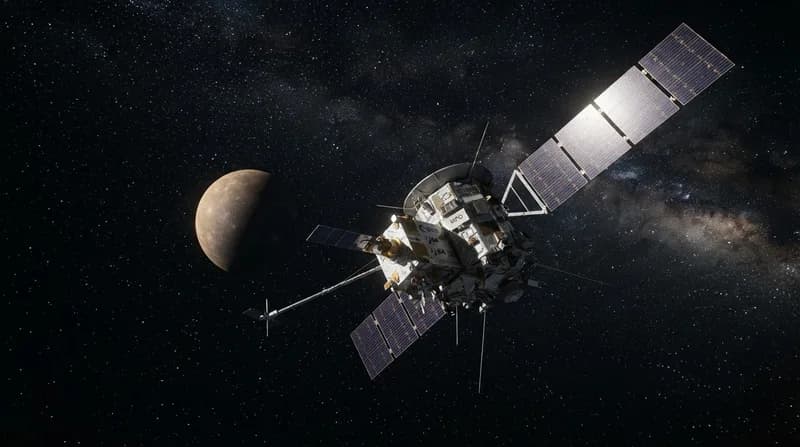
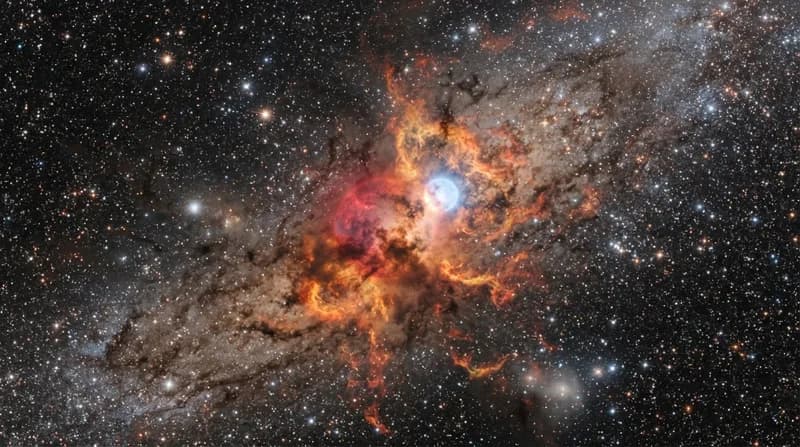
In a landmark discovery for stellar astrophysics, researchers have observed a dramatic collision between two stars in the neighboring Andromeda galaxy. The event, which resulted in the creation of a single, "rejuvenated" star nicknamed Bao, marks the first time scientists have observed such a merger in such exquisite detail. By leveraging the unparalleled sensitivity of NASA's James Webb Space Telescope (JWST), the team was able to analyze the system just 47 days after the final, eruptive phase of the merger, providing a rare real-time look at how stars evolve and interact during their final stages of life.
The system, officially designated AT 2025abao, consisted of a massive supergiant—christened "Big Bao"—and a smaller companion, "Little Bao." Before the collision, Big Bao was a celestial titan, boasting 7,000 times the mass of the Sun and shining with 18,000 times its brightness. For years, the pair existed in a stable binary orbit, but the system's fate was sealed when the smaller star began dipping into the outer atmosphere of its massive partner, initiating a process known as common envelope evolution.
The Mechanics of Common Envelope Evolution
Common envelope evolution is a critical phase in the life cycle of binary stars where the stars become encased in a shared, gaseous outer layer. As the smaller star orbits through the dense, gaseous envelope of its companion, it experiences significant drag, causing it to lose orbital energy and spiral steadily toward the primary star's core. In the case of Bao, this process accelerated rapidly. While theoretical models often suggest such interactions take thousands of years, the final unification of these two stars reached completion in just seven orbits, covering a span of roughly seven years.
The culmination of this spiral was violent and decisive. When the smaller star finally plunged into the heart of the supergiant, it released a massive burst of energy. Researchers likened the event to a bomb detonating deep within the structure of a living star. This cataclysmic interaction forced the system to expel vast amounts of gas and dust into the surrounding space, a phenomenon that JWST was uniquely positioned to capture using its mid-infrared instruments.
Why it Matters
- Understanding Cosmic Extremes: Studying common envelope evolution is essential for explaining the origins of gravitational waves, black holes, and neutron stars.
- Validating Simulations: Comparing real-time observations from JWST against computer models helps refine our understanding of how binary systems transition and potentially survive such encounters.
- Predictive Astronomy: This discovery highlights the success of multi-observatory monitoring, proving that we can track transient stellar events from early warning signs to their explosive conclusions.
A New Era for Transient Astronomy
The successful documentation of the Bao system was not an isolated incident but the result of a coordinated, long-term monitoring effort involving multiple space-based and ground-based assets. Initial signs of instability were detected as far back as 2023, when researchers noticed subtle, atypical changes in the system's luminosity. By the time the Zwicky Transient Facility recorded the peak eruption in October 2025, the global astronomical community was ready, with instruments like the Neil Gehrels Swift Observatory and the Gemini North telescope providing essential data before JWST stepped in to finalize the analysis.
Looking ahead, the tools used to capture this event are only the beginning. With the launch of the Nancy Grace Roman Space Telescope, astronomers anticipate a significant increase in the discovery rate of similar transient phenomena. Through extensive sky surveys like the Galactic Bulge Time-Domain Survey, researchers hope to move beyond observing isolated incidents and begin building a statistical understanding of how common these stellar mergers truly are, and what diverse forms they take across the cosmos.