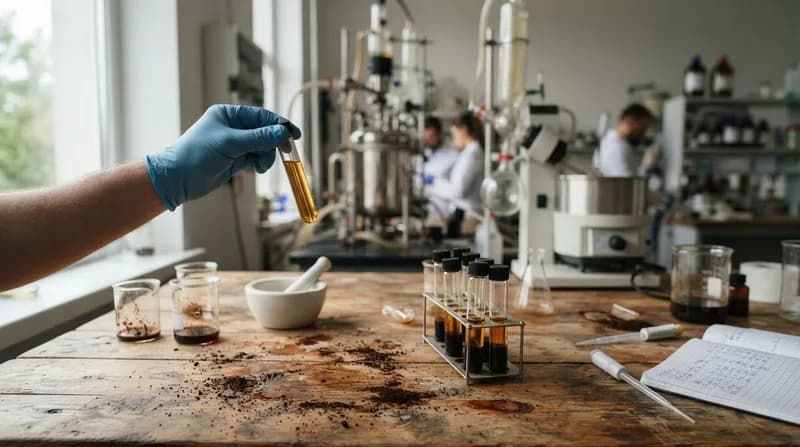
A Second Life for Your Morning Brew
Every year, the global coffee industry generates roughly 10 million metric tons of spent coffee grounds. While the vast majority of this material ends up as solid waste, researchers at the Universitat Rovira i Virgili (URV) have discovered that these grounds are sitting on a goldmine of renewable energy. By applying a sophisticated yet practical extraction method, the team has successfully identified a way to harvest high-quality lipids, which serve as a foundational ingredient for biodiesel, without destroying the utility of the remaining biomass.
The study, published in the journal Biomass and Bioenergy, moves beyond theoretical chemistry to present a scalable solution for industrial biorefineries. By focusing on optimizing variables such as temperature, processing time, and solvent ratios, the team has turned a labor-intensive laboratory process into a streamlined operation that could significantly reduce the environmental footprint of global coffee consumption.
The Optimized Extraction Process
To identify the most efficient way to capture these valuable oils, the URV researchers conducted a series of systematic tests using n-hexane as a solvent. They meticulously adjusted parameters to find the 'sweet spot' for extraction. Their findings concluded that the optimal conditions for recovery involve a temperature of 45°C, a processing duration of 60 minutes, and a specific ratio of 35 milliliters of hexane per gram of dry residue.
The results of this refined approach are striking. The team achieved a recovery rate of approximately 90% compared to standard laboratory methods, but with a significant leap in quality. The oil produced through this optimized batch process contained only 0.3% impurities, vastly outperforming traditional methods that often yield nearly 4% impurities. This purity level is critical, as it ensures that the resulting biodiesel feedstock remains consistent and high-performing.
Beyond Biodiesel: Valorizing the Biomass
One of the most significant aspects of the URV study is the preservation of the 'lignocellulosic matrix'—the structural foundation of the coffee grounds. Many previous methods for extracting fats from organic waste left the remaining material unusable. By carefully managing the extraction, the researchers ensured that the remaining solids could still be converted into additional renewable resources, such as bioethanol, lactic acid, and even precursors for sustainable aviation fuels.
Furthermore, the removal of the oils actually improves the secondary processing of the coffee grounds. Lipids often act as a barrier, preventing catalytic agents from reaching the core of the plant matter. By stripping away these fats, the remaining cellulose, hemicellulose, and lignin become more accessible for industrial conversion. This dual-purpose strategy transforms coffee waste into a multi-layered resource, supporting a circular economy that benefits sectors difficult to electrify, such as heavy transport and aviation.
Why it Matters
- Circular Economy: Converts an massive, underutilized waste stream into a renewable fuel source.
- Industrial Scalability: The process favors conventional batch extraction, making it easier for existing biorefineries to adopt without radical infrastructure changes.
- Resource Efficiency: The method maximizes the value of the grounds by extracting fuel oils while simultaneously preparing the byproduct for further chemical synthesis.
- Sustainability: Provides a carbon-conscious alternative for sectors like long-haul trucking and air travel that currently rely heavily on fossil fuels.