ScienceTechnical Deep Dive

Cosmic Pulse: Astronomers Detect Strange Eight-Minute Radio Signal from Distant Dead Star

Published
EElectricBuzz Editorial Team
Cosmic Pulse: Astronomers Detect Strange Eight-Minute Radio Signal from Distant Dead Star
3 min read504 wordsElectricBuzz Editorial Team

The Gist

“A newly discovered binary system 5,000 light-years away has revealed a white dwarf spinning at an eight-minute interval, providing a rare window into stellar magnetic activity.”

A New Frontier in Deep Space Transients

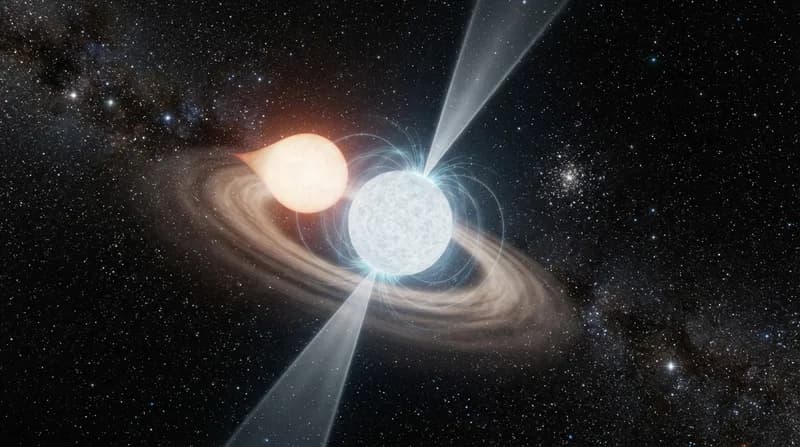
In a groundbreaking observation that challenges our understanding of binary star systems, astronomers at the International Centre for Radio Astronomy Research (ICRAR) have identified a remarkable stellar pair located over 5,000 light-years from Earth. The system, cataloged as GPM J071507−114153, features a white dwarf—the dense, scorched remnant of a dead star—locked in an orbital dance with a companion remarkably similar to our own Sun. The most striking characteristic of this system is the rhythmic, repeating radio pulse emitted by the white dwarf every eight minutes.

This discovery places the pair into an elusive category known as long-period transients (LPTs). These objects are defined by their sporadic radio emissions that flicker into existence and vanish over timescales ranging from minutes to hours. While LPTs have been a subject of intense scrutiny since their initial discovery in 2021, pinning down the exact source of these signals has historically been difficult. This new observation provides the clearest evidence yet that the radio emissions originate directly from the vicinity of the white dwarf.

Mapping the Magnetic Storms

Beyond the intrigue of the eight-minute pulses, the study offered an unprecedented look at the magnetic environment of a distant star. By tracking the white dwarf as it moved through its orbit, researchers were able to observe the object passing behind its companion, a G-type star. This passage revealed high-energy interactions between the two celestial bodies, including evidence of a stellar prominence—an immense, looping structure of plasma and magnetic fields erupting from the Sun-like star's surface.

The ability to detect such granular activity across 5,000 light-years represents a significant leap forward in radio astronomy. These stellar prominences operate much like the magnetic processes on our own Sun that drive terrestrial space weather, such as auroras. This finding confirms that the complex magnetic interactions that govern our solar system are also at play in distant, vastly different configurations, offering a 'Rosetta Stone' for interpreting cosmic magnetic phenomena.

Technical Infrastructure and Future Outlook

  • Observation Methodology: The system was first flagged by the Murchison Widefield Array (MWA) in Western Australia during a comprehensive survey of the Milky Way.
  • Precise Tracking: Researchers utilized the MeerKAT radio telescope in South Africa to finalize the object's precise spatial coordinates.
  • Optical Confirmation: The W.M. Keck Observatory in Hawaii provided the optical data required to classify the companion star as a G-type, Sun-like star.
  • Computational Power: Over 100 hours of radio data were processed at the Pawsey Supercomputing Research Centre to model the white dwarf’s orbital motion.

Looking ahead, this discovery serves as a high-stakes proof of concept for the Square Kilometre Array (SKA) project. As astronomers move from current precursor telescopes like the MWA and MeerKAT to the much higher-sensitivity SKA-Low and SKA-Mid facilities, the frequency of these discoveries is expected to skyrocket. These future observatories will likely turn what is currently a rare astronomical curiosity into a rich, mappable population of celestial objects, allowing researchers to fully decode the mysteries of long-period transients and the hidden life cycles of stars.

SPONSORED
The 5 Best Over-Ear ANC Headphones of 2026, Tested & Ranked
Editor's Pick Guide
92/100
Tech & Gadgets•12 min read

The 5 Best Over-Ear ANC Headphones of 2026, Tested & Ranked

We locked five over-ear ANC picks for 2026 — Sony WH-1000XM6, Bose QuietComfort Ultra 2, Soundcore Space One, Sennheiser Momentum 5, and Apple AirPods Max 2 — then stress-tested them on lab metrics, long-term owner truth, and live street prices.

Related Stories

Semantically matched articles, ranked by topic overlap and freshness.

Crafting the 'Unicorn Career': Navigating Professional Uncertainty in the Age of AI
Science

Crafting the 'Unicorn Career': Navigating Professional Uncertainty in the Age of AI

STEM career expert Alaina G. Levine breaks down how to design a deeply personal, value-aligned career trajectory in a rapidly shifting technological landscape.

Cracking the Barium Titanate Code: A Quantum Leap for Optical Networking
Science

Cracking the Barium Titanate Code: A Quantum Leap for Optical Networking

A joint research team has finally decoded the complex optical properties of barium titanate, clearing the path for faster, more efficient data transmission.

BepiColombo’s X-Ray Vision: A Deep-Space Triumph Eight Years in the Making
Science

BepiColombo’s X-Ray Vision: A Deep-Space Triumph Eight Years in the Making

After an eight-year journey spanning 10 billion kilometers, the BepiColombo mission has successfully activated its groundbreaking X-ray telescope, signaling a new era for planetary exploration.

A Day in the Void: Voyager 1 Reaches Historic One-Light-Day Milestone
Science

A Day in the Void: Voyager 1 Reaches Historic One-Light-Day Milestone

NASA's legendary Voyager 1 probe has officially crossed the one-light-day threshold, marking a new chapter in the farthest-reaching human endeavor in history.

Breakthrough 'Molecular Glue' Offers New Hope for RAS-Driven Cancers
Science

Breakthrough 'Molecular Glue' Offers New Hope for RAS-Driven Cancers

A novel therapeutic, ERAS-0015, is showing remarkable promise in clinical trials for treating aggressive, hard-to-target lung and pancreatic cancers.

The Hidden Chemical Threat: How Microplastics Interact with Water to Damage Cells
Science

The Hidden Chemical Threat: How Microplastics Interact with Water to Damage Cells

A groundbreaking study from Columbia University reveals that microplastics are not just inert physical intruders; they actively trigger dangerous chemical reactions within the human body.

Stellar Collision Course: The Hidden Engines Feeding Sagittarius A*
Science

Stellar Collision Course: The Hidden Engines Feeding Sagittarius A*

Astronomers have uncovered a cosmic food chain in the heart of our galaxy, linking a powerful binary star system to the steady fuel supply of the Milky Way's supermassive black hole.

Mapping the Genetic Blueprint of Immune Aging
Science

Mapping the Genetic Blueprint of Immune Aging

Researchers at Monash University have mapped the genetic mechanisms behind immune system decline, offering new hope for targeted cancer and infection therapies.