Solving a Decades-Old Cosmic Riddle
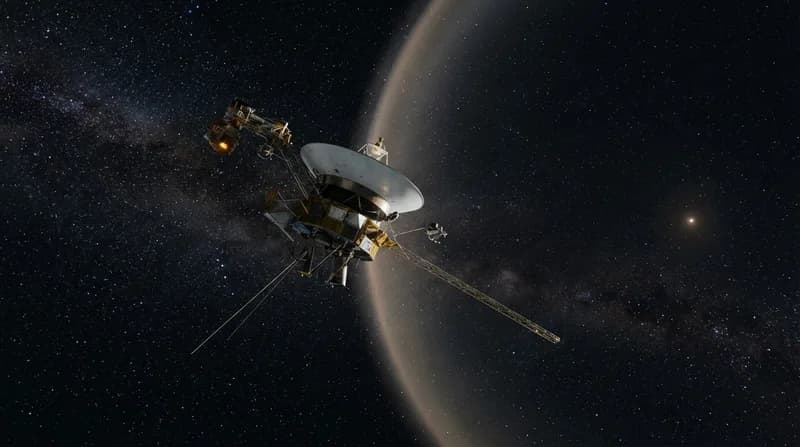
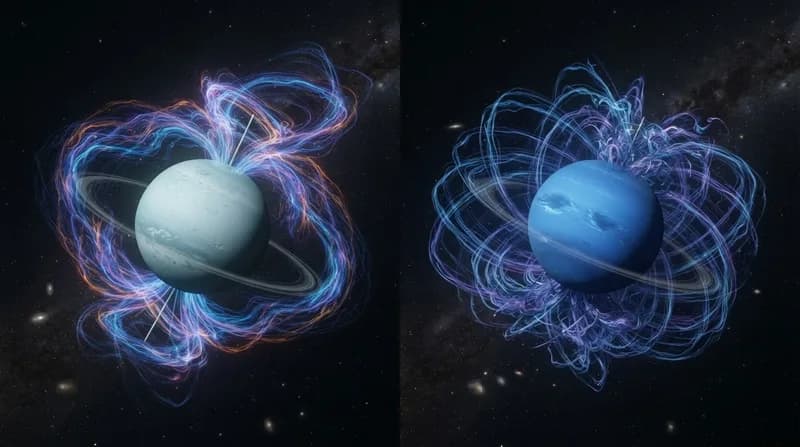
When NASA's Voyager 2 spacecraft swept past Uranus and Neptune in the 1980s, it sent back data that left planetary scientists scratching their heads. Unlike the relatively stable, dipole-aligned magnetic field of Earth, these two distant ice giants exhibited wildly tilted and distorted magnetic structures. For nearly forty years, these observations remained a primary point of confusion in planetary science. Now, a breakthrough study from the University of Texas at Austin, alongside international collaborators, may have finally cracked the code, suggesting that the secret lies in the extreme electrical conductivity hidden deep within these massive worlds.
The Dynamo Behind the Chaos
Planetary magnetic fields are generated by a process known as a dynamo, where moving, electrically conductive fluids deep inside a planet create magnetic currents. On Earth, this happens in the outer core, where molten iron circulates in a fairly orderly fashion, keeping our magnetic north and south poles relatively consistent. However, the conditions within Uranus and Neptune are vastly different. These planets are comprised of a complex mixture of water, ammonia, methane, and hydrogen under gargantuan pressures and temperatures.
Lead researcher Chi Yan and the team posit that as you descend into the interiors of these ice giants, the pressure becomes so intense that water molecules break apart into ions. This creates a gradient where electrical conductivity increases with depth. By integrating this specific behavior into high-fidelity computer simulations, the research team successfully recreated the irregular magnetic fields observed by Voyager 2. Their model highlights that the specific internal stratification of these planets is not just a structural curiosity—it is the primary driver of their anomalous magnetic behavior.
A Dynamic Shift
Perhaps the most provocative revelation from the study is the potential for temporal instability. While Earth's magnetic tilt shifts at a glacial pace—moving only about a degree every 50 years—the simulations suggest that Uranus and Neptune may be far more volatile. According to the models, the magnetic axes of these ice giants could potentially swing by tens of degrees within just a few decades.
This means the magnetic environment Voyager 2 captured four decades ago may not represent the state of the planets today. This discovery shifts the perception of these ice giants from static, frozen worlds to dynamic, evolving environments where the very orientation of their magnetic influence is in constant flux.
Why it Matters
- Understanding Planetary Evolution: Unraveling how magnetic fields are generated helps scientists understand the internal composition and thermal history of planets beyond our own.
- Refining Dynamo Theory: The inclusion of pressure-dependent electrical conductivity challenges existing models, forcing a rethink of how we simulate planetary interiors.
- The Hunt for Real-Time Data: The study provides a target for current observation campaigns, moving the focus from historical data toward active, long-term monitoring.
New Frontiers in Observation
While current computer models have provided the necessary theoretical framework, the researchers are already looking for physical evidence to confirm these rapid shifts. The James Webb Space Telescope (JWST) is playing a critical role in this endeavor. By studying the auroras of Uranus and Neptune, astronomers can gain a window into the state of the planets' ionospheres. Because auroras are intrinsically linked to magnetic field lines, any significant change in their structure or behavior acts as a proxy for shifts in the underlying magnetic dynamo. Moving forward, the synthesis of these cutting-edge telescopic observations with advanced numerical simulations may finally provide a definitive answer to one of the solar system’s most enduring mysteries.