E-BUZZ ME Logo
ScienceTechnical Deep Dive

Bumble Bees Stun Researchers by Solving Classic Intelligence Test

Published
Bumble Bees Stun Researchers by Solving Classic Intelligence Test
2 min read282 words

The Gist

In a groundbreaking study, bumble bees demonstrated spontaneous problem-solving by using tools to reach rewards, challenging long-held beliefs about insect cognition.

Researchers from the University of Oulu, the University of Helsinki, and the University of Turku have discovered that bumble bees (Bombus terrestris) possess the ability to solve complex, unfamiliar problems without prior training. This discovery, published in the journal Science, suggests that spontaneous problem-solving is not exclusive to humans and large-brained vertebrates.

The 'Box-and-Banana' Experiment for Insects

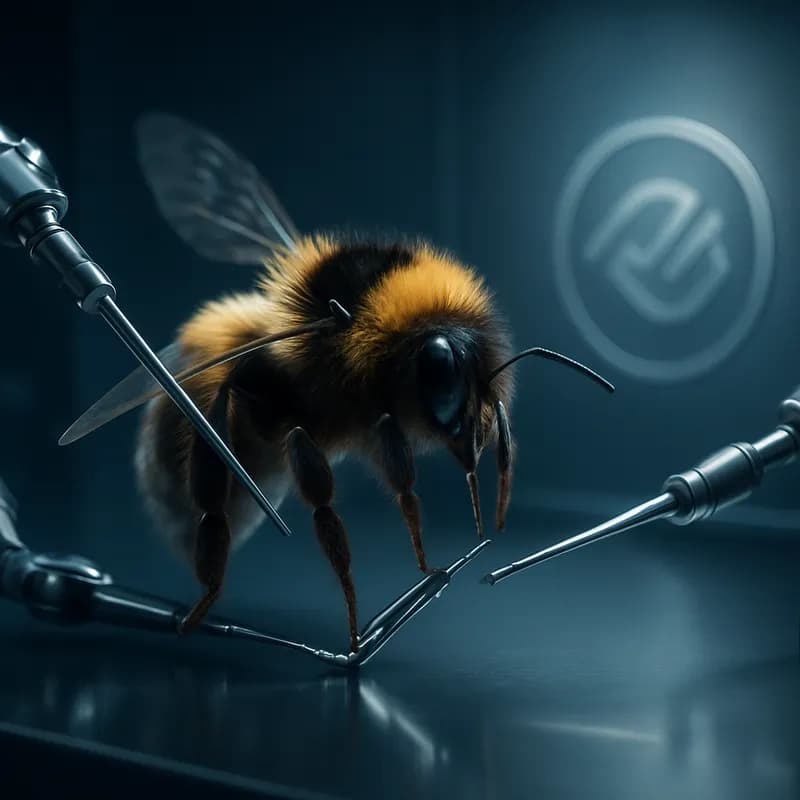
The study adapted a classic intelligence test originally used on chimpanzees. Researchers placed a reward-filled artificial flower on the ceiling of an arena, making it inaccessible. To reach it, the bees had to move a small ball underneath the flower and climb on top of it. Despite never being taught this sequence, several bees successfully manipulated the ball to reach the goal.

"This is essentially an insect version of the classic 'box-and-banana' problem," noted senior author Olli Loukola. The bees had previously learned that the flower contained food and that the ball was movable, but combining these two facts into a functional solution was a completely spontaneous act of insight.

Ruling Out Trial and Error

To ensure the results weren't the product of accidental success or simple visual guidance, the team conducted stringent control experiments. In some trials, the flower was hidden from view while the bees moved the ball, yet the insects still positioned the tool correctly. These results indicate that the movements were goal-directed rather than random exploration.

Tiny Brains, Flexible Solutions

The findings add to a growing body of evidence regarding the sophisticated cognitive abilities of bees, including social learning and cooperation. While the researchers clarify that this does not mean insects think exactly like humans, it proves that miniature brains can generate flexible, innovative solutions to novel challenges.


Related Stories

Semantically matched articles, ranked by topic overlap and freshness.

AI Aids Stanford Researchers in Discovering Natural Weight Loss Molecule
Science63%

AI Aids Stanford Researchers in Discovering Natural Weight Loss Molecule

Stanford scientists have identified a natural molecule that mimics the weight-loss effects of Ozempic with fewer side effects by targeting specific brain regions.

Ancient Egyptian Ape Fossil Challenges Established Human Evolutionary Timeline
Science62%

Ancient Egyptian Ape Fossil Challenges Established Human Evolutionary Timeline

A newly discovered fossil in northern Egypt suggests the ancestors of modern apes and humans may have emerged in North Africa rather than East Africa.

Sweden Explores Rare Earth Deposits to Challenge Global Supply Dominance
Science61%

Sweden Explores Rare Earth Deposits to Challenge Global Supply Dominance

Researchers are mapping Sweden's mineral wealth to create magnets from natural element combinations, aiming to reduce reliance on Chinese exports.

The Future of Open Access: Navigating Structural Challenges and AI Integration
Science61%

The Future of Open Access: Navigating Structural Challenges and AI Integration

As the scientific community pushes for an open-access future, experts warn that systemic issues and the rise of AI must be addressed to ensure sustainability.

New Giant Salamander Species Identified from 3.5-Million-Year-Old Japanese Fossils
Science60%

New Giant Salamander Species Identified from 3.5-Million-Year-Old Japanese Fossils

Researchers have identified a new genus and species of giant salamander, Limnospondylus ajimuensis, from fossils originally discovered over two decades ago.

U.S. Schools Struggle with Concussion Support for Returning Students
Science60%

U.S. Schools Struggle with Concussion Support for Returning Students

A new study reveals that many public schools lack the necessary policies and staff training to support students recovering from concussions.

The Economic Hurdles Facing GLP-1 Weight Loss Drugs
Science60%

The Economic Hurdles Facing GLP-1 Weight Loss Drugs

While drugs like Ozempic and Wegovy offer significant health benefits, their high costs pose a major challenge to insurance budgets and patient access.

Longevity-Linked APOE2 Gene Found to Shield Brain from Aging and Alzheimer’s
Science60%

Longevity-Linked APOE2 Gene Found to Shield Brain from Aging and Alzheimer’s

Researchers have discovered that the APOE2 gene variant protects neurons by reducing DNA damage and enhancing stress recovery, offering a potential blueprint for new Alzheimer’s therapies.