A New Frontier in Molecular Quantum Physics
In a significant leap for nanotechnology and quantum science, researchers at the Max Planck Institute for the Science of Light (MPL) have achieved a milestone that has long eluded the scientific community: reaching the ultimate quantum limit for individual molecules placed on a physical surface. This breakthrough, recently detailed in the journal Science, paves the way for unprecedented control over quantum emitters, potentially revolutionizing how we approach quantum computing and secure communication.
For years, the primary challenge in studying quantum emitters—tiny objects like atoms or molecules that interact with light—has been environmental instability. To observe these quantum properties, researchers typically rely on vacuum traps or solid-state integration. Surfaces, while ideal for using advanced probes like scanning tunneling microscopy (STM) to manipulate matter, have historically been too "noisy" and contaminated to preserve delicate quantum states. These microscopic disturbances have always caused quantum coherence to collapse far sooner than theoretically predicted.
The Solution: A Self-Cleaning Crystal Technique
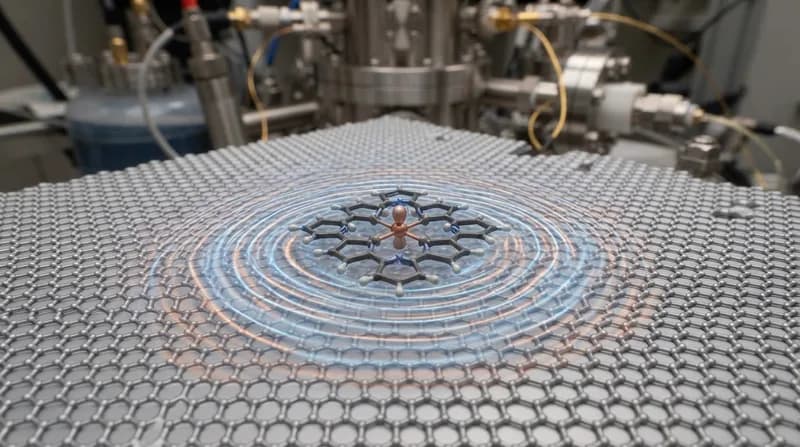
The research team, led by Professor Vahid Sandoghdar, successfully circumvented the contamination issue by leveraging a natural, elegant process known as sublimation. By working with organic crystals, the team utilized a clever cleaning protocol that functions almost like a self-polishing surface. Inside a cryogenic vacuum chamber, the crystal was allowed to slowly evaporate its top layers, essentially casting off any impurities or contaminants that had accumulated on the surface.
Once the surface reached a state of pristine purity, the team cooled the crystal to temperatures just a few degrees above absolute zero. This extreme environment effectively locked the crystal in place, halting the sublimation process and creating an ultra-stable foundation. Using a specialized miniature oven, researchers then deposited individual molecules onto this "clean room" surface, providing the quantum emitters with a calm, disturbance-free environment to interact with light.
Understanding the Fourier Limit
The success of the experiment was measured by the molecules' coherence time—the duration for which a quantum system remains stable enough to maintain its quantum properties. In physics, there is an absolute boundary known as the "Fourier limit." This represents the maximum possible duration coherence can last before a system naturally releases its energy into the surroundings.
Prior to this development, surface-bound quantum systems would lose coherence hundreds or even thousands of times faster than this limit due to ambient noise. The MPL team observed that molecules on their ultra-clean crystals consistently maintained coherence exactly at the Fourier limit. This confirms that their method effectively nullifies the detrimental effects of the surrounding environment, keeping the quantum state preserved for the absolute maximum time allowed by the laws of physics.
Why It Matters
- Quantum Precision: Achieving the Fourier limit allows researchers to study the interaction between molecules and surfaces with unprecedented accuracy.
- Nanometer Control: The findings open the door to combining this technique with scanning probe microscopy to physically nudge or align individual quantum emitters.
- Future Tech: By mastering the ability to manipulate individual molecules on surfaces, scientists are building the foundational infrastructure required for next-generation quantum computers and highly secure, light-based communication networks.
Moving forward, the team aims to integrate this surface-cleaning protocol with atomic force microscopy to achieve nanometer-scale manipulation of these quantum states, offering a glimpse into a future where we can engineer custom quantum matter from the ground up.