A New Perspective on Cosmic Evolution
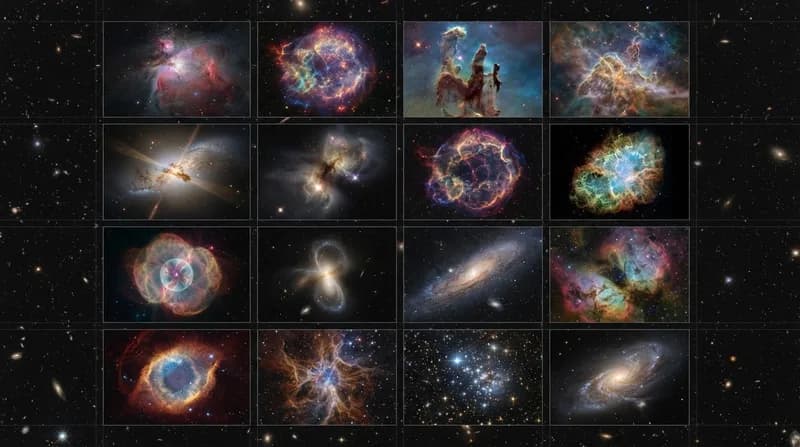
NASA has unveiled a spectacular new gallery featuring 16 galaxies, captured through the multi-wavelength lens of our most advanced orbital observatories. By synthesizing data from the Chandra X-ray Observatory, the James Webb Space Telescope, the Hubble Space Telescope, and various other specialized instruments like NuSTAR and IXPE, astronomers have produced images that transcend mere aesthetics. These high-definition portraits expose the hidden, high-energy processes—such as supermassive black hole outbursts, explosive star formation, and colossal galactic collisions—that define the structural history of the universe.
For researchers, these images serve as vital diagnostic tools. X-ray data from Chandra is particularly critical, as it reveals million-degree gas and high-energy phenomena that remain invisible to optical telescopes. By layering this data with the infrared precision of Webb and the visual clarity of Hubble, scientists can map how chemical elements are redistributed through space, eventually seeding the building blocks for future planets and, potentially, life.
Spiral Galaxies: The Engines of Star Birth
The collection highlights several spiral galaxies, offering a masterclass in stellar dynamics. Galaxies like Messier 33 and NGC 3938, observed from a top-down orientation, provide a clear look at their sprawling arms and the energetic remnants of past stellar explosions. These structures are not static; they are active factories. In barred spirals like NGC 1672 and NGC 1385, internal gravitational bars act as pipelines, funneling gas and dust toward the galactic center to fuel bursts of new star creation.
Other spiral systems exhibit signs of external influence. NGC 4725, for instance, shows clear markers of a historical encounter with a neighbor, which triggered a surge in star formation. Meanwhile, edge-on views of the Whale Galaxy (NGC 4631) and the iconic Cigar Galaxy (Messier 82) reveal the dramatic "exhaust systems" of the universe. In these cases, intense stellar explosions drive million-degree gas winds thousands of light-years away from the galactic disk, effectively regulating the growth of the galaxy and enriching the intergalactic medium.
The Power of Active Galactic Nuclei
Some of the most violent activity in the gallery originates from the hearts of galaxies. Centaurus A is a prime example of a galaxy housing an active galactic nucleus, where a central supermassive black hole launches high-energy particle jets spanning tens of thousands of light-years. These jets interact with surrounding gas, physically altering the environment of the entire host galaxy.
Messier 106 demonstrates a more unusual phenomenon: jets launched from a central black hole that heat surrounding gas in such a way that they create anomalous spiral structures, distinct from the galaxy’s traditional stellar arms. Even the elegant Sombrero Galaxy (Messier 104) is shown to hide a tumultuous core. Beneath its famous dust bands, Chandra’s X-ray observations reveal a supermassive black hole surrounded by a gargantuan halo of million-degree gas, illustrating that even the most serene-looking galaxies are often sites of immense, invisible energy.
Collisions and the Future of the Milky Way
The gallery also captures the chaotic reality of galactic mergers. Arp 143 serves as a striking reminder of cosmic gravitational force; a direct collision between two galaxies resulted in an expanding ring of material, reminiscent of a shockwave in a pond. This event sparked a massive wave of new star births, showcasing how destructive forces can ultimately drive galactic evolution.
These snapshots are not just distant curiosities; they are mirrors of our own future. Astronomers anticipate that the Milky Way will eventually undergo a merger with the Andromeda galaxy. By studying systems like NGC 3256 and II Zw 096, scientists can better model the long-term transformation of our own cosmic home. The gallery also features oddities like NGC 660, with its rare polar ring, and Messier 90, which is currently being stripped of its star-forming gas as it navigates the dense environment of the Virgo Cluster.