The Strategic Shift
VinFast is signaling a major shift in its Indian operations just one year after its initial market entry. The Vietnamese automaker, which arrived with ambitious plans to leverage its global lineup, is recalibrating its approach after discovering that its existing models—specifically the VF 6 and VF 7—could not meet the aggressive cost-efficiency benchmarks required to gain a foothold in India’s hyper-competitive electric vehicle landscape. Consequently, the company has hit the brakes on its localization plans for these global vehicles, prompting a pivot toward the development of two India-specific models, internally codenamed VF X and VF Y.
This strategic realignment is fundamentally about affordability. By involving local suppliers early in the design and engineering process, VinFast hopes to bypass the cost constraints associated with importing high-value knocked-down kits. The company is actively collaborating with approximately 200 Indian suppliers to utilize existing tooling and localized components, aiming to bring vehicle production costs into line with the price sensitivity of the local consumer base.
The Entry-Level Contender: VF X
The VF X is envisioned as the cornerstone of this new strategy. Currently in the design phase, it is targeted at an extremely competitive price point of under US$12,000, or approximately 1.15 million rupees. In terms of market positioning, VinFast is targeting the segment currently dominated by popular domestic models like the Tata Punch.ev and Nexon.ev. While the precise dimensions are still being finalized, the VF X is expected to slot between the ultra-compact VF 3 and the larger VF 6, offering a crossover silhouette tailored for urban driving.
The challenge for the engineering team remains balancing the desired SUV footprint with the strict cost-reduction targets. By focusing on a vehicle that is uniquely designed for the Indian road environment and the Indian supply chain, VinFast believes it can achieve the economies of scale that have so far eluded its global models in this specific region.
Why It Matters
- Pricing Power: The US$12,000 target is critical for penetrating the mass market in India, where price remains the primary driver of EV adoption.
- Supply Chain Localization: Transitioning from simple assembly of imported kits to genuine, localized manufacturing is essential for sustainable growth and government incentives.
- Market Responsiveness: The shift shows that global legacy platforms often require significant adaptation for emerging markets, particularly in regions dominated by domestic heavyweights.
Infrastructure and Outlook
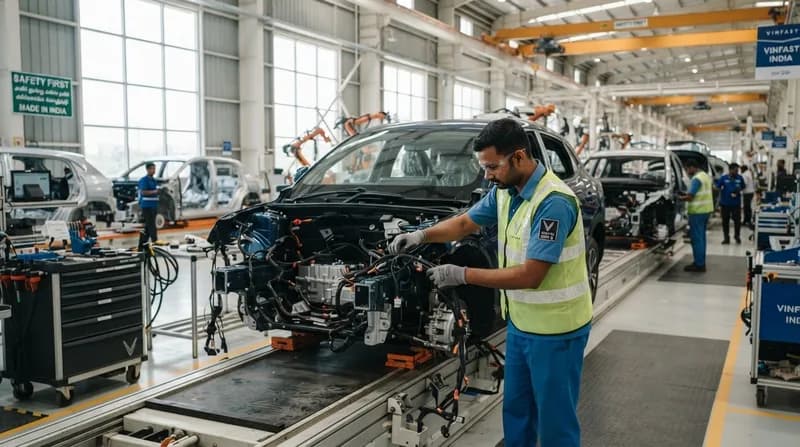
VinFast’s current facility in Thoothukudi, Tamil Nadu, serves as the heart of its Indian operations. While the plant has an impressive annual production capacity of 50,000 EVs—with the potential to scale up to 150,000—current utilization is significantly lower. Having sold approximately 10,000 vehicles since the launch of the VF 6 and VF 7 in late 2025, the company is clearly looking for a higher volume catalyst.
The decision to pause development work on the previously planned localized global models and shift resources toward the VF X and VF Y indicates a pragmatic, albeit expensive, realization. By prioritizing long-term market fit over short-term expediency, VinFast is attempting to secure its place in India’s rapidly evolving electric mobility ecosystem, even if it means redesigning its roadmap from the ground up.