The Challenge of Immune Evasion
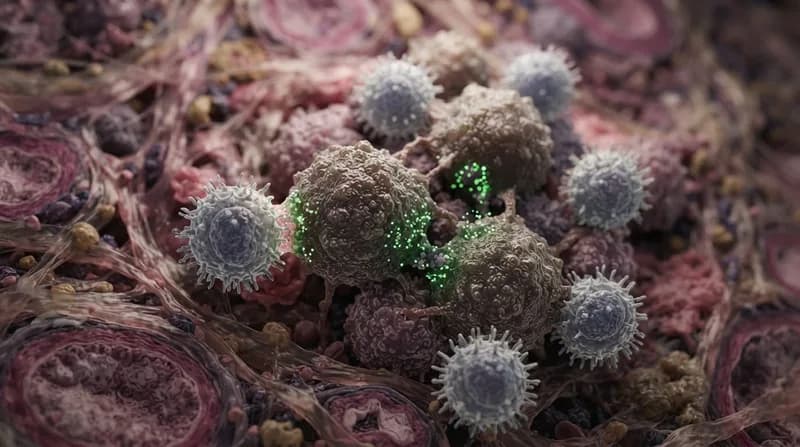
For decades, cancer immunotherapy has focused primarily on supercharging the immune system—releasing the molecular 'brakes' on T cells or engineering them to be more aggressive. However, a major hurdle remains: many solid tumors, including those found in the pancreas, prostate, and brain, are considered 'immunologically cold.' These tumors effectively evade detection, leaving even the most potent immune cells with nothing to target.
New research from the Dana-Farber Cancer Institute, published in the journal Immunity, suggests that we have been looking at the problem from the wrong direction. The study reveals that the issue is not just the weakness of our immune system, but the deceptive nature of the tumors themselves. Cancer cells possess the ability to manipulate their own 'molecular window display,' preventing them from showcasing the very mutations that would otherwise make them vulnerable to attack.
The p53 Mystery and the Immunopeptidome
At the heart of this evasion strategy is the TP53 gene, which carries mutations in roughly half of all human cancers. Scientists have long hoped that because these mutations are 'truncal'—meaning they appear early and are present in almost every cell of a tumor—they would be the ideal target for T cell therapies. However, clinical results have often fallen short of these expectations.
Using an ultrasensitive mass spectrometry platform, researchers investigated why these mutations remain hidden. They discovered that while DNA sequencing might predict a target, the cell's actual 'immunopeptidome'—the collection of protein fragments displayed on the cell surface—often fails to include those targets. In many cases, the mutations are poorly processed by the cell or lack the necessary stability to be held by HLA molecules on the surface, rendering them invisible to patrolling T cells.
Strategic Shifts: ERAP1 and Beyond
The research team identified specific mechanisms tumors use to maintain this invisibility. For instance, in tumors harboring the p53 I195F mutation, an enzyme called ERAP1 acts as an overzealous trimmer, chopping up the antigenic fragments before they can ever reach the cell surface. By inhibiting ERAP1, the researchers successfully restored the visibility of these cancer cells to T cells in laboratory models.
Another common mutation, p53 R175H, presented a different challenge: the resulting protein-HLA complex was physically unstable. The study highlights that even if a T cell receptor is capable of recognizing a target, the target itself must remain anchored to the cell surface long enough for the immune system to initiate an attack. These findings suggest that simply having a 'good' T cell is insufficient if the tumor is actively scrubbing its surface of evidence.
Why It Matters: The Immunopeptidome Shift
The potential for a new class of therapeutics lies in the concept of an 'immunopeptidome shift.' Rather than just attempting to improve T cell recognition, the goal is to use drugs to force cancer cells to display a wider, more visible array of antigens. This approach holds several key implications for future cancer care:
- Broadening the Target Scope: By manipulating RNA splicing or using small molecules to alter peptide fit, doctors could expose multiple new targets simultaneously, making it much harder for a tumor to evade treatment through mutation alone.
- Overcoming 'Cold' Tumors: This method could transform immunologically quiet tumors into 'hot' tumors, finally opening the door for effective use of checkpoint inhibitors in notoriously difficult cancers like glioblastoma and pancreatic cancer.
- Enhancing Existing Therapies: The researchers emphasize that this strategy is not a replacement but a complement. It could be used in tandem with existing CAR-T, TCR-T, and checkpoint inhibitors, essentially 'priming' the tumor to be seen so the immune system can do its job.
The Road Ahead
While the study demonstrates proof-of-concept in controlled settings, the transition to clinical application remains the next frontier. The researchers advocate for a shift in how we approach neoantigen drug development. Moving forward, the focus must be on whether a mutation is actually processed, presented, and stabilized on the cell surface, rather than relying solely on genetic predictions. By forcing the tumor to reveal its true face, researchers may finally have the missing piece to the immunotherapy puzzle.