Reimagining Digestive Research at the Microscale
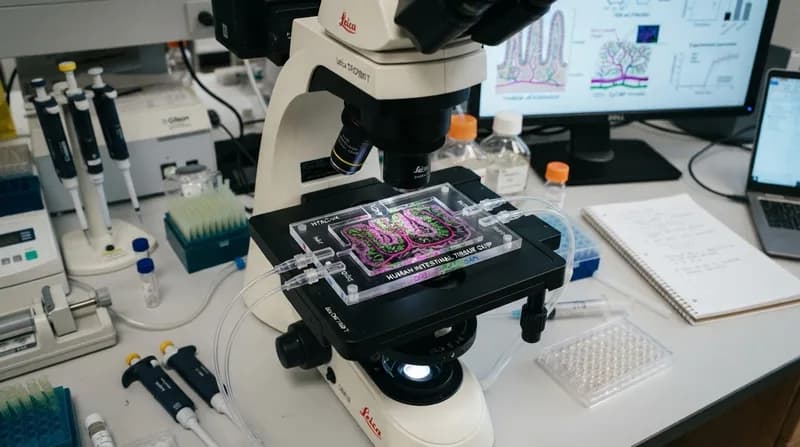
The human gut is arguably one of the most complex, high-traffic biological environments in existence. Stretching meters in length and possessing a massive surface area optimized for nutrient absorption, it plays a critical role in human health through its interaction with a vast, diverse ecosystem of microorganisms. Studying this environment has historically been a significant challenge for researchers, often relying on simplified models that fail to capture the physical topography of the small intestine. Now, a team from Lawrence Livermore National Laboratory (LLNL) has achieved a breakthrough by recreating the gut’s signature 'crypt-villi' architecture—the complex landscape of cavities and finger-like protrusions—on a microfluidic device no larger than a standard microscope slide.
This new 'gut-on-a-chip' represents a significant departure from previous organ-on-a-chip technologies, which often struggled to replicate the necessary three-dimensional complexity to mimic human physiology accurately. By utilizing advanced stereolithographic 3D printing and precise protein crosslinking, the team has successfully fabricated a scaffold that provides the structural integrity required for human intestinal cells to thrive and exhibit realistic behaviors in a controlled laboratory setting.
The Technical Innovation: 3D Printing Physiological Complexity
The core of the LLNL breakthrough lies in the fabrication process. The researchers utilized a specialized bioresin based on gelatin methacrylate (GelMA) to print the intricate 3D scaffolding. To ensure the biological environment was as hospitable as possible for human tissue, they employed an enzyme-mediated protein crosslinking technique, which significantly enhances cell viability. This allows the cultured cells to behave more like they would within the human body, facilitating the study of complex human-microbe interactions that were previously difficult to monitor.
The physical design of the device also sets it apart from predecessors. It features a unique, removable gasket system that houses the human tissue while simultaneously sealing the fluidic chambers. This architectural choice is crucial; it allows researchers to cultivate cells separately off-chip using standard incubation equipment before integrating them into the testing environment. This modularity not only simplifies the experimental workflow but also opens the door for future iterations where the chip could be adapted to model other organs or even interconnected organ systems for multi-organ research.
Why It Matters
- Temporal Resolution: Unlike animal models that often provide only a single snapshot of data, this chip allows for frequent and extensive real-time sampling, revealing upstream biological events as they occur.
- Reducing Animal Testing: This biomimetic platform provides a more accurate alternative to traditional in vivo studies, potentially accelerating drug discovery and disease modeling.
- Predictive Power: The inclusion of machine learning models allows researchers to analyze the data gathered from the chip to make educated predictions about microbiome health and the systemic effects of various treatments.
- Scalability: By creating a reliable, reproducible, and modular environment, this technology enables scientists to stress-test the gut system in ways that were previously deemed impossible.
Future Implications for Clinical Research
The ability to 'peek' inside the gut with such high resolution is a game-changer for gastroenterology and general digestive health. As lead researcher Nicholas Be noted, the team can now 'poke' at the system in various ways and observe the unfolding results in real-time. This capability to perform dynamic, longitudinal studies will likely lead to deeper insights into how the gut microbiome influences human health, potentially unlocking new pathways for treating inflammatory diseases, metabolic disorders, and other conditions linked to intestinal function. With the integration of predictive machine learning, this microscopic chip is poised to become a cornerstone tool in the next generation of precision medicine.