Breaking the Nanosecond Bottleneck
In the quest for near-instantaneous computing and high-speed telecommunications, the manipulation of light has long been constrained by the physical limits of electronic components. Most current light-steering technologies, such as those found in high-end projectors and telecommunications infrastructure, rely on electrical signals to modulate light. These systems force electrons into higher energy states, a process that inherently requires time for excitation and relaxation, typically capping speeds at the nanosecond or picosecond level.
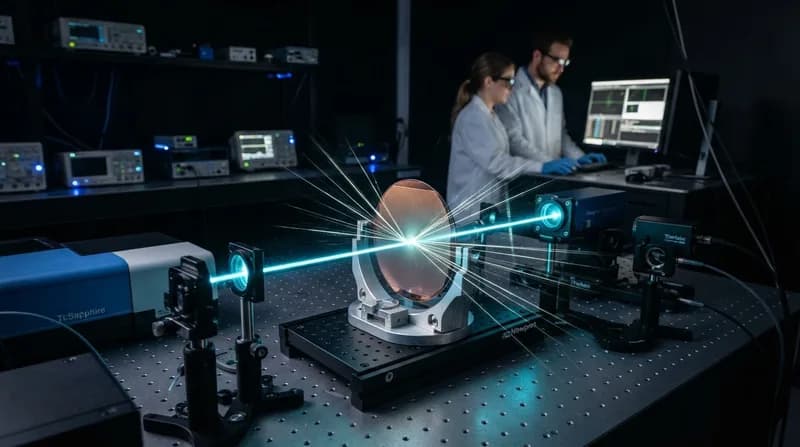
A team of researchers at Caltech has shattered this barrier by bypassing electrical input entirely. By utilizing a cutting-edge device that steers light using another beam of light, the team successfully demonstrated redirection in just 74 femtoseconds. To put this into perspective, a femtosecond is one quadrillionth of a second—a timescale so minuscule that 74 of them represent the amount of time it takes light to traverse the diameter of a human hair.
The Power of the Optical Kerr Effect
The innovation centers on the optical Kerr effect, a phenomenon where an intense beam of light—referred to as the 'pump'—temporarily alters the refractive index of a material. Unlike electronic modulation, which requires electrons to transition between energy states, the Kerr effect involves subtle shifts in electron motion within their orbitals. Because there is no need for electronic relaxation, the alteration is near-instantaneous, vanishing as soon as the pump light pulse passes.
However, the Kerr effect is notoriously weak in standard materials, making it insufficient for practical engineering applications. To overcome this, the Caltech researchers engineered a specialized metasurface constructed from a thin film of amorphous silicon. This surface is precision-patterned with an array of nanoscale pillars. These structures are specifically designed to trap light, forcing it to circulate within the metasurface rather than passing straight through. This increased interaction time effectively amplifies the refractive index change, creating a robust response strong enough to steer a secondary 'probe' beam by up to 13 degrees.
Why It Matters
- Beyond Electronics: Eliminating electrical signals removes the primary bottleneck in photonic modulation, enabling data processing speeds orders of magnitude faster than existing technology.
- Miniaturization: The use of nanoscale silicon pillars demonstrates how metasurfaces can manipulate light in ultra-thin, highly integrated footprints suitable for future chip architectures.
- Future-Proofing: The study suggests that current speeds are capped only by the duration of the laser pulses themselves, opening the door to even faster modulators as pulse technology evolves.
- New Paradigms: This research provides a foundational building block for emerging fields like time crystals and synthetic time-varying optical materials, which could redefine how we store and compute information.
An Outlook on Photonic Computing
The implications of this development extend far beyond the laboratory. By demonstrating the ability to reconfigure optical paths on a femtosecond timescale, Caltech has provided a roadmap for a new generation of all-optical computers and advanced sensors. While the current prototype relies on high-energy pump pulses, the researchers believe that as laser technology and metasurface engineering mature, these components could be scaled for commercial integration.
As we approach the limits of what traditional silicon-based transistors can achieve in terms of thermal management and raw speed, light-based computing offers a path forward. This breakthrough confirms that it is possible to achieve high-efficiency, reconfigurable beam steering on a chip-scale device, effectively bridging the gap between theoretical physics and next-generation photonic infrastructure.