The Rise of Pocket-Sized Particle Physics
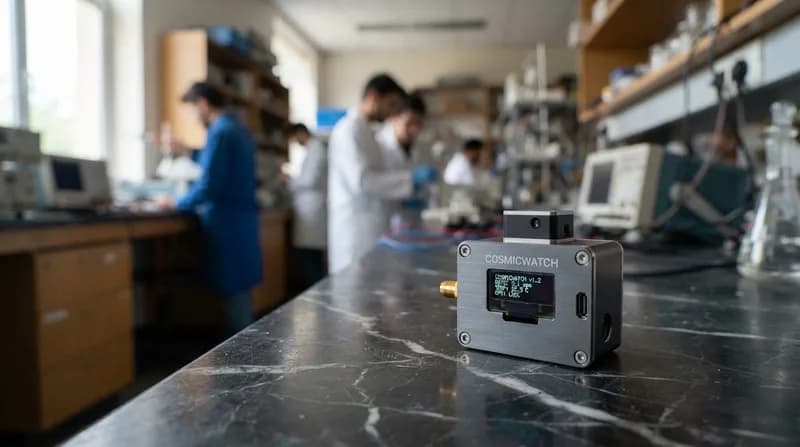
For decades, detecting cosmic rays—the high-energy particles emanating from violent phenomena like supernovae and blazars—required massive, expensive, and stationary laboratory equipment. Today, that paradigm is shifting thanks to CosmicWatch, a compact, $100 detector that allows anyone to see the invisible stream of subatomic particles constantly raining down on Earth. Roughly the size of a box of animal crackers, this device marks a breakthrough in democratizing experimental physics.
Developed by University of Delaware assistant professor Spencer Axani, the project originated during his graduate studies at MIT. What began as a specialized tool for the IceCube observatory in Antarctica has blossomed into a versatile, portable hardware platform. By monitoring muons—secondary particles created when cosmic rays strike Earth’s atmosphere—the device provides researchers and students alike with a reliable way to capture data that was once the exclusive domain of major, multi-million dollar research facilities.
The Technology Behind the Flash
The core functionality of CosmicWatch relies on high-speed electronics capable of recording a count every time a muon passes through the device. The third version of the hardware, recently detailed in the Journal of Instrumentation, introduces significant improvements in durability and environmental awareness. This iteration can monitor its surroundings, operate effectively under higher radiation conditions, and process data at substantially faster rates than its predecessors.
Beyond its low price point, the device is modular. Enthusiastic researchers have demonstrated its adaptability by integrating external sensors for temperature and pressure, enabling high-altitude balloon experiments that track how cosmic ray flux changes as one approaches the edge of space. This design philosophy bridges the gap between theoretical physics education and hands-on, high-stakes research.
Why It Matters
- Cost-Effective Research: Replaces bulky, bookshelf-sized lab equipment with a portable, affordable hardware solution.
- Educational Impact: Encourages students to build, code, and troubleshoot real-world sensors, fostering a deeper understanding of particle physics.
- Scalable Data Collection: Offers the potential for a global network of citizen-scientists to monitor atmospheric muon activity simultaneously.
- Extraterrestrial Utility: Ongoing development focuses on space-rated versions that could help satellites and spacecraft navigate harsh space environments by detecting solar flares in real-time.
Beyond the Classroom: From Dark Matter to Satellites
The applications for CosmicWatch extend far beyond educational outreach. The device is currently integrated into major physics projects, including the NuDot experiment and the Coherent CAPTAIN-Mills dark matter detector in Los Alamos. Its ability to provide precise, calibrated measurements in a compact form factor makes it an ideal tool for researchers who need to maintain sensitivity in large-scale detector arrays.
The future of the technology may lie in orbital infrastructure. By deploying these detectors on satellites, researchers hope to create an intelligent communication network in space. If a solar flare or radiation surge is detected by one unit, the information could be relayed to nearby spacecraft, allowing them to enter a protective low-power mode. As thousands of these detectors have already been built over the past eight years, the vision of a connected, planetary-scale particle sensing grid is quickly becoming a reality, proving that the most profound insights into the universe can sometimes come from the most modest of devices.