The Challenge of Nanoplastic Accumulation
As micro- and nanoplastics continue to permeate our global food chain and water supplies, the scientific community has been racing to identify how these synthetic contaminants impact long-term human health. Measuring less than a micrometer in size, nanoplastics are particularly insidious because they are small enough to cross the intestinal barrier, potentially accumulating in critical organs such as the kidneys, liver, and even the brain. While the environmental crisis of plastic waste is well-documented, finding biological interventions to mitigate their internal residence time has proven to be an uphill battle for researchers.
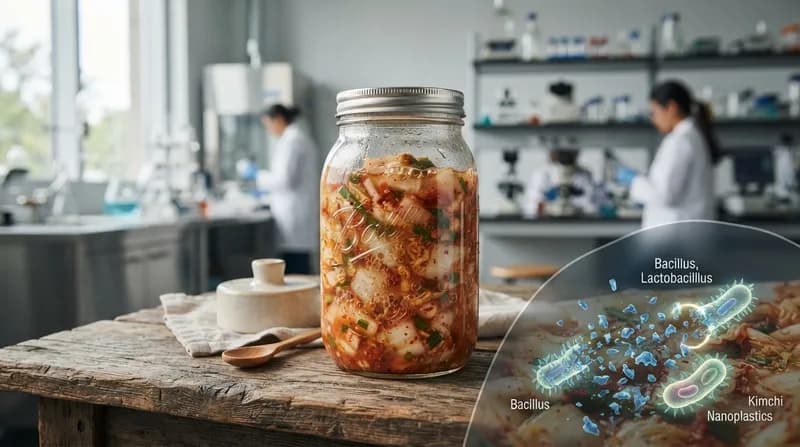
A promising breakthrough has emerged from the World Institute of Kimchi in South Korea, where scientists have identified a natural, probiotic solution to this modern dilemma. By examining the unique microbial landscape of traditional fermented foods, researchers have discovered that the power to trap these plastics may already be sitting on our dinner tables.
The Role of Leuconostoc mesenteroides CBA3656
The star of this discovery is a specific strain of lactic acid bacteria known as Leuconostoc mesenteroides CBA3656. In controlled laboratory environments, this bacterium displayed a remarkable capacity for biosorption—the process of binding to contaminants—effectively latching onto polystyrene nanoplastics with an 87% efficiency rate. While many bacteria can bind to particles in a sterile lab dish, the true test for any probiotic is its ability to function within the harsh, unpredictable environment of the human digestive tract.
In comparative studies, the CBA3656 strain demonstrated significant resilience. While other common probiotic strains saw their binding efficacy collapse from 85% to a mere 3% under simulated intestinal conditions, the kimchi-derived bacterium maintained an impressive 57% adsorption rate. This stability suggests that the strain is uniquely equipped to survive the transition through the gut, maintaining its physical structure and binding properties even in the presence of digestive enzymes and varying pH levels.
Evidence From Animal Models
To move beyond petri dishes, the research team employed a germ-free mouse model to observe the bacterium's behavior in a biological system. The results were striking: mice administered the CBA3656 probiotic excreted more than double the amount of nanoplastics in their feces compared to the control group. This data indicates that the bacterium acts as a biological magnet, tethering itself to plastic particles in the gut and facilitating their excretion before they can permeate the intestinal wall and migrate into the bloodstream.
Why it Matters
- Non-Invasive Strategy: Unlike synthetic chemical treatments, this approach utilizes natural probiotics, which carry a lower risk of side effects and offer a dietary-based intervention.
- Addressing Micro-Pollutants: This research expands the scope of probiotic studies, shifting focus from traditional digestive health to the neutralization of environmental toxins.
- Public Health Implications: With nanoplastics increasingly linked to inflammatory and chronic conditions, this discovery provides a potential mechanism for reducing the total body burden of synthetic materials in humans.
Future Implications for Public Health
The research, published in the journal Bioresource Technology, highlights a shift in how we perceive the intersection of food science and environmental toxicology. By leveraging the microbial richness of fermented foods, scientists may be able to offer a new layer of protection against the hidden plastics we consume daily. Dr. Se Hee Lee, the lead researcher on the project, notes that while this is a burgeoning field, the results provide a compelling argument for the proactive use of fermented microbial resources as a tool for public health defense.
Looking ahead, the team plans to continue evaluating the scalability of this finding, exploring how such strains could be integrated into dietary guidelines. While eating kimchi is not a cure-all for the world's plastic crisis, this study marks a vital step in discovering biological pathways that might help us coexist with the micro-pollutants currently inherent in the modern food supply.