ScienceTechnical Deep Dive

Unlocking the Mechanism of Aging: How 'Zombie' Cells Drive Chronic Inflammation

Published
EElectricBuzz Editorial Team
Unlocking the Mechanism of Aging: How 'Zombie' Cells Drive Chronic Inflammation
3 min read511 wordsElectricBuzz Editorial Team

The Gist

New research reveals how senescent cells exploit mitochondrial pathways to trigger systemic inflammation, offering a potential breakthrough in extending human healthspan.

The Mechanics of Aging and Senescence

Chronic inflammation is a hallmark of the aging process, acting as a silent driver for many of the degenerative diseases that plague older populations. While the immune system is designed to trigger a temporary inflammatory response to combat infection or injury, it is supposed to deactivate once the threat is neutralized. However, as humans age, the body accumulates cells known as senescent—or 'zombie'—cells. These cells cease to divide yet remain metabolically active, secreting inflammatory molecules in a process referred to as the senescence-associated secretory phenotype (SASP).

A collaborative team of researchers from the Sanford Burnham Prebys Medical Discovery Institute and the Mayo Clinic has successfully mapped the molecular bridge that links these zombie cells to chronic, systemic inflammation. Their findings, recently published in the journal Nature, demonstrate that the persistence of SASP is not merely an accident of aging but a specific, exploitable biological pathway driven by mitochondrial dysfunction.

The Dual-Pathway Convergence

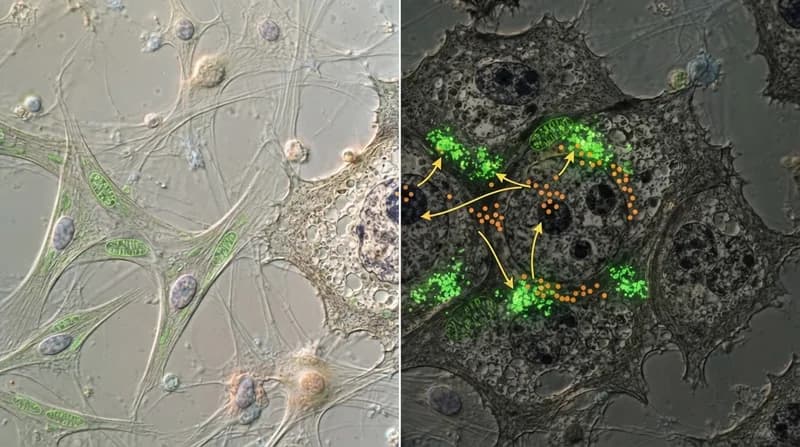
The research reveals that the inflammatory behavior of senescent cells relies on a two-step convergence of mitochondrial signals. First, the mitochondria in these cells produce an excess of acetyl-CoA. This molecule interacts with histones—the proteins responsible for packaging DNA—effectively 'loosening' the genetic structure. This process makes previously hidden inflammatory genes more accessible to the cell's machinery, essentially priming the cell to launch an inflammatory program.

However, accessibility is only half of the equation. The second step involves the leakage of mitochondrial DNA and RNA into the body of the cell, where they act as 'danger signals.' The immune system misidentifies this misplaced genetic material as a threat, activating transcription factors that switch on the inflammatory genes that were already primed by the metabolic changes. Without this synergistic partnership between metabolic priming and immune signaling, the inflammatory response would not be sustained.

Why it Matters: Implications for Longevity

  • Targeted Intervention: By identifying that metabolism influences genetic accessibility, researchers have opened a new frontier for therapeutic interventions that go beyond traditional immune-suppressing drugs.
  • Healthspan vs. Lifespan: The goal of this research is to improve 'healthspan'—the period of life spent in good health—rather than just extending the total number of years lived.
  • New Pharmaceutical Targets: The identification of the acetyl-CoA pathway provides a concrete target for small-molecule inhibitors that could mitigate age-related functional decline.

A Potential Therapeutic Breakthrough

To validate their findings, the research team utilized a compound known as CTPI-2, which functions by blocking a specific transport protein required for the production of acetyl-CoA. When administered to mice, the results were highly encouraging. Despite the continued presence of leaky mitochondrial DNA and the resulting immune signals, the inhibition of the metabolic pathway prevented the SASP genes from becoming accessible.

By 'locking' these inflammatory genes away, the drug significantly reduced tissue-wide inflammation and directly improved the healthspan and physical function of the test subjects. This discovery suggests that we do not necessarily need to eliminate zombie cells entirely; rather, by disrupting the specific metabolic signals that fuel their inflammatory output, we may be able to significantly dampen the systemic toll of aging on the human body.


The 5 Best Over-Ear ANC Headphones of 2026, Tested & Ranked
Editor's Pick Guide
92/100
Tech & Gadgets12 min read

The 5 Best Over-Ear ANC Headphones of 2026, Tested & Ranked

We locked five over-ear ANC picks for 2026 — Sony WH-1000XM6, Bose QuietComfort Ultra 2, Soundcore Space One, Sennheiser Momentum 5, and Apple AirPods Max 2 — then stress-tested them on lab metrics, long-term owner truth, and live street prices.

Related Stories

Semantically matched articles, ranked by topic overlap and freshness.

NASA's Roman Space Telescope Set for Two Decades of Cosmic Discovery
Science

NASA's Roman Space Telescope Set for Two Decades of Cosmic Discovery

Thanks to exceptional launch precision and significant fuel savings, the Nancy Grace Roman Space Telescope is poised to more than double its mission life, potentially operating for over 22 years.

Unlocking Predictive Markers: How B Cells Could Forecast Immunotherapy-Induced Colitis
Science

Unlocking Predictive Markers: How B Cells Could Forecast Immunotherapy-Induced Colitis

New research from MD Anderson Cancer Center suggests that B cell activity acts as a crucial early-warning system for identifying patients at risk of developing severe colitis during cancer treatment.

Could a Tiny Brain Protein Be the Master Switch for Aging?
Science

Could a Tiny Brain Protein Be the Master Switch for Aging?

Researchers have identified that declining levels of a brain protein called Menin may drive systemic aging, offering a potential new target for age-related health interventions.

Challenging Einstein: Scientists Pioneer Gravity Tests Using Exotic Muonium Atoms
Science

Challenging Einstein: Scientists Pioneer Gravity Tests Using Exotic Muonium Atoms

Researchers at ETH Zurich have developed a method to create controlled beams of muonium, potentially enabling the first-ever gravitational tests on second-generation particles.

Unlocking the Narrative: AI System Transforms Physician Notes into Actionable Medical Data
Science

Unlocking the Narrative: AI System Transforms Physician Notes into Actionable Medical Data

A groundbreaking study reveals how a new AI system can parse clinical prose at scale, converting hidden patient insights into verifiable, computer-readable data.

Caltech’s Femtosecond Breakthrough: Steering Light with Light
Science

Caltech’s Femtosecond Breakthrough: Steering Light with Light

Researchers have engineered a nanoscale silicon metasurface capable of redirecting light beams in just 74 quadrillionths of a second, shattering traditional speed barriers in photonic computing.

Beyond the Starch: Why Black and Green Rice Are Emerging as Metabolic Superfoods
Science

Beyond the Starch: Why Black and Green Rice Are Emerging as Metabolic Superfoods

New research from Hokkaido University reveals that pigmented rice varieties contain unique, beneficial fats that could revolutionize dietary approaches to blood sugar management.

Biological Breakthrough: Scientists 3D-Print a Functional Human Gut-on-a-Chip
Science

Biological Breakthrough: Scientists 3D-Print a Functional Human Gut-on-a-Chip

Researchers at Lawrence Livermore National Laboratory have successfully replicated the complex 3D architecture of the human small intestine on a compact, microfluidic device.