The Anatomy of Choice
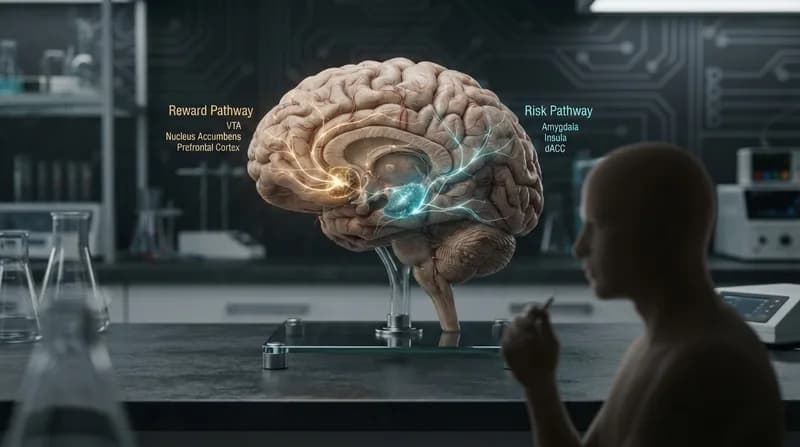
Every day, our brains perform a constant, complex calculation: should we push forward or pull back? Whether it is deciding to run a red light when in a hurry or choosing to place a risky bet, these split-second decisions define our lives. A groundbreaking new study from researchers at UC San Francisco and UC Berkeley has successfully identified the precise neural mechanism behind these choices, pinpointing two neighboring regions in the orbitofrontal cortex that compete to control our behavior.
Published in Nature Neuroscience, the study utilized intracranial recordings from patients who already had electrodes implanted for epilepsy treatment. By monitoring brain activity on a millisecond-by-millisecond basis, the team discovered that when a person is weighing a risky decision, two distinct patches of the brain essentially engage in a tug-of-war. One region, located near the middle of the eyebrow, signals a preference to take the risk, while a separate patch about two centimeters away fires in opposition to trigger an avoidant response.
The Immersive Game of Risk
Traditional studies on human decision-making have historically relied on fMRI scans. However, the orbitofrontal cortex is located behind the eyes, an area notoriously difficult to image accurately due to interference from nearby sinuses. Moreover, participants in traditional studies often struggle with engagement, failing to exhibit the genuine motivation required to make high-stakes choices. To solve this, researchers designed a custom, high-stakes video game where participants navigated dangerous, bomb-filled mazes to reach virtual treasure.
This immersive approach ensured that the patients were genuinely invested in the outcomes, providing a far more realistic view of how the brain processes risk in real-time. By observing this neural activity through the electrodes, the researchers could actually predict a participant's choice half a second before they physically acted. The data showed that for easy choices—such as a path with high reward and no risk—the decision was nearly instantaneous. For more complex, ambiguous choices, the two neural patches oscillated, signaling a back-and-forth internal debate before one side eventually secured a victory.
Why It Matters
- Beyond Linear Models: Unlike previous models that viewed decision-making as a slow, linear accumulation of evidence, this research demonstrates that the brain operates like a high-speed switch oscillating between two distinct extremes.
- Targeted Psychiatry: Current psychiatric treatments for conditions like OCD, depression, and gambling addiction are often broad, affecting large areas of the brain with inconsistent results. Mapping these specific neural circuits offers a blueprint for much more localized and effective brain stimulation.
- Objective Diagnostics: The findings move psychiatry closer to an objective, measurable science. Instead of relying solely on patient self-reporting, clinicians could potentially measure neural activity to assess if a patient's risk-assessment circuit is functioning abnormally, allowing for personalized, circuit-specific interventions.
A New Frontier for Psychiatric Treatment
The implications of this discovery for mental health are profound. Patients struggling with obsessive-compulsive disorder or severe depression often grapple with an excessive, debilitating urge to avoid risks, while those with addiction disorders may struggle with impulsive, unhealthy risk-taking. By understanding that these behaviors are driven by a literal imbalance in specific, identifiable neural circuits, medical professionals can begin to move away from systemic treatments toward precise, corrective stimulation.
Looking ahead, the goal is to shift the psychiatric landscape from subjective mood scores to objective, physiological markers. As researchers continue to refine the understanding of how these signals translate into human action, the potential to "rebalance" the brain’s tug-of-war could provide relief for millions, offering a concrete, scientific pathway to helping patients achieve more balanced decision-making in their daily lives.