A Hidden Oasis Beneath the Surface
For more than sixty years, a sprawling underwater structure off the coast of Benin sat in the annals of marine science as a defunct relic. Initial surveys conducted in the 1960s, which were primarily focused on identifying viable fishing grounds, had labeled the deep-water coral formation as dead. However, a recent expedition led by researchers from the Institut de Recherches Halieutiques et Océanologiques du Bénin has upended that narrative, proving that the reef is not only alive but acting as a vital hub for marine life.
The discovery was made possible by modern advancements in imaging and sonar technology. Armed with the National Geographic Exploration Technology Lab's Deep Sea Camera System and high-resolution sonar, the team retraced the historical survey path. Located over 50 meters below the surface, the site exists as a mesophotic coral ecosystem—a unique zone where light is limited, forcing the coral to grow in distinct, scattered patches across rocky sections of the seafloor rather than as one continuous wall.
Technological Triumphs in Marine Exploration
The mission was fraught with technical hurdles and the inherent difficulty of operating in deep-water environments. The research team first employed sonar to map 11.5 kilometers of the seabed, identifying two high-potential zones that matched the signatures of coral growth. Once identified, the team deployed an underwater drone and the specialized camera system, effectively acting as a high-tech trail camera on the ocean floor.
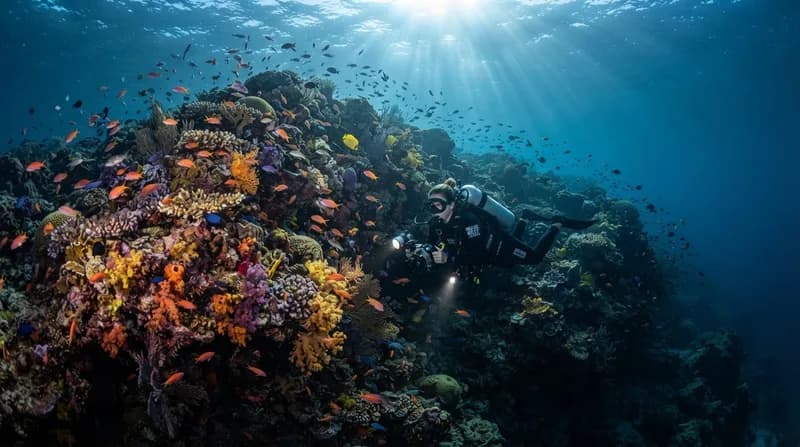
What the footage revealed surprised the scientific community. The area is home to at least eight distinct types of coral and a diverse array of fish species, including golden African snappers, Guinean angelfish, and three-banded butterflyfish. These creatures utilize the patchy reef structure for shelter and feeding, suggesting a robust, albeit specialized, ecosystem. The researchers believe this is the first confirmed, living mesophotic reef on the Gulf of Guinea continental shelf, indicating that the region may hold significantly more biological wealth than previously documented.
Why it Matters
- Redefining Biodiversity: The survival of this reef suggests that West African coastal waters may contain a network of overlooked ecosystems.
- Historical Misinterpretation: The finding questions whether early surveys were inaccurate or if the reef underwent a massive recovery, providing a unique look at ocean resilience.
- Technological Necessity: This success highlights how modern, non-invasive imaging tools allow researchers to revisit historical data with unprecedented clarity and precision.
Future Outlook: An Uncharted Frontier
While the initial findings are undeniably exciting, the team maintains a measured approach. The current data comes from a limited number of visual transects, and physical sampling has yet to be conducted to verify species identifications. The original historical reports hinted at a potential 40-kilometer-long barrier reef system, suggesting that what the team discovered may only be a small fraction of a much larger, sprawling network.
The researchers are now calling for a comprehensive scientific diving and sampling program to further investigate the site. By studying the history of these corals, scientists hope to unlock a better understanding of how the ocean’s climate in this region has evolved over the past century. As the team moves forward, they view this reef as an untouched archive of marine history—one that, once again, serves as a reminder of how much of our own planet remains hidden in the deep.