ScienceTechnical Deep Dive

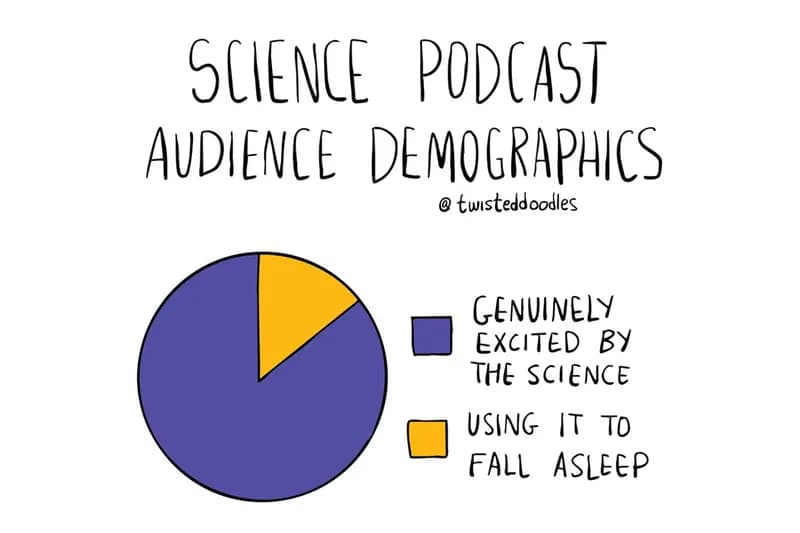
TwistedDoodles Explores the Demographics of Science Podcast Listeners

Published
EElectricBuzz Editorial Team
TwistedDoodles Explores the Demographics of Science Podcast Listeners
1 min read126 wordsElectricBuzz Editorial Team

The Gist

“The latest illustration from TwistedDoodles offers a humorous take on the diverse audience tuning into science-themed digital broadcasts.”

The popular webcomic TwistedDoodles has released a new illustration this week focusing on the specific demographics associated with science podcasting. Known for blending scientific curiosity with everyday humor, the artist provides a visual commentary on who exactly is consuming educational audio content today.

A Visual Breakdown

The cartoon highlights the various archetypes found within the science podcast community, ranging from professional researchers to curious hobbyists. By utilizing a relatable art style, TwistedDoodles captures the growing cultural footprint of science communication and the diverse motivations that drive listeners to seek out complex topics during their daily routines.

As digital media continues to evolve, these types of social observations shed light on how scientific discourse has moved from academic journals into the mainstream ears of the general public.

SPONSORED
The 5 Best Over-Ear ANC Headphones of 2026, Tested & Ranked
Editor's Pick Guide
92/100
Tech & Gadgets•12 min read

The 5 Best Over-Ear ANC Headphones of 2026, Tested & Ranked

We locked five over-ear ANC picks for 2026 — Sony WH-1000XM6, Bose QuietComfort Ultra 2, Soundcore Space One, Sennheiser Momentum 5, and Apple AirPods Max 2 — then stress-tested them on lab metrics, long-term owner truth, and live street prices.

Related Stories

Semantically matched articles, ranked by topic overlap and freshness.

MIT’s Dual-Action Strategy Breathes New Life Into Toxic Antibiotic Candidates
Science

MIT’s Dual-Action Strategy Breathes New Life Into Toxic Antibiotic Candidates

Researchers have developed a clever 'drug and antidote' delivery system that renders previously unusable, highly toxic compounds safe for fighting bacterial infections.

Harvard’s Microscopic UV Chip Could Shrink Quantum Computers to Desktop Size
Science

Harvard’s Microscopic UV Chip Could Shrink Quantum Computers to Desktop Size

Researchers have developed a breakthrough lithium niobate photonic device that generates high-power ultraviolet light on a chip, potentially revolutionizing quantum computing and sensor technology.

PicoQuant’s Solira Streamlines the Hunt for the Perfect Quantum Emitter
Science

PicoQuant’s Solira Streamlines the Hunt for the Perfect Quantum Emitter

A new integrated microscopy platform is changing how researchers verify solid-state quantum emitters, bridging the gap between discovery and real-world quantum application.

Paleontology’s Biggest Case of Mistaken Identity: The Fossil That Wasn't a Reptile
Science

Paleontology’s Biggest Case of Mistaken Identity: The Fossil That Wasn't a Reptile

A 345-million-year-old fossil known as 'Lizzie' has been revealed to be an aquatic creature, forcing a massive rewrite of how vertebrates first stepped onto land.

Natural Synergy: Omega-3 and Aspirin Show Promise as Antibiotic Alternative for Gum Disease
Science

Natural Synergy: Omega-3 and Aspirin Show Promise as Antibiotic Alternative for Gum Disease

A year-long clinical trial reveals that a simple daily regimen of omega-3 and low-dose aspirin can match the efficacy of antibiotics in treating severe periodontitis.

Scientists Engineer 'Invisible Pipes' Using Acoustic Levitation
Science

Scientists Engineer 'Invisible Pipes' Using Acoustic Levitation

Researchers have developed a groundbreaking method to transport liquids and gases through mid-air using programmable ultrasonic sound waves, effectively creating an invisible conduit.

Quantum Precision: DNA Nanotechnology Opens New Frontiers in Bioimaging
Science

Quantum Precision: DNA Nanotechnology Opens New Frontiers in Bioimaging

Researchers at the Technical University of Munich have pioneered a DNA-based quantum sensor that uses spin chemistry to detect and potentially control biological processes at the molecular level.

Stanford AI Breakthrough Uncovers Three Hidden Biological 'Biotypes' for ADHD and Anxiety
Science

Stanford AI Breakthrough Uncovers Three Hidden Biological 'Biotypes' for ADHD and Anxiety

Researchers have utilized deep learning to identify three distinct brain connectivity patterns that redefine how we understand and diagnose childhood ADHD and anxiety.