The Deceptive Icon of Early Evolution
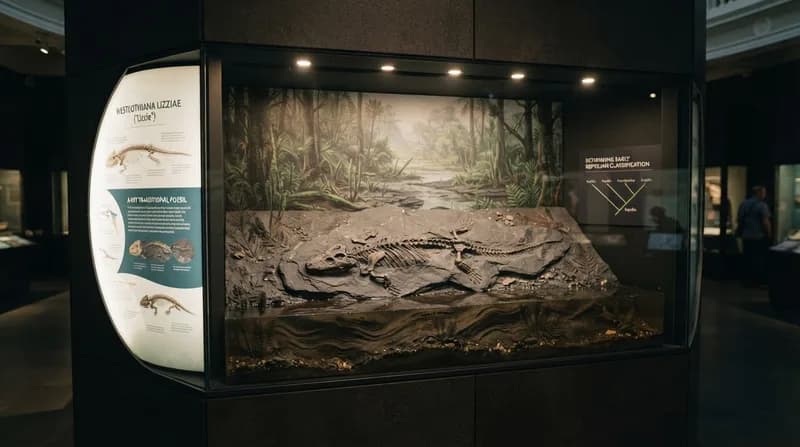
For nearly thirty years, the fossil of Westlothiana lizziae—affectionately known as “Lizzie”—has served as a foundational pillar in our understanding of vertebrate evolution. Discovered in Scotland in 1984, the specimen was long held up as the gold standard for the earliest known amniote, a group that includes modern reptiles, birds, and mammals. Its outward appearance, characterized by claw-like digits and a sturdy frame, suggested a creature that had successfully made the leap from aquatic life to a permanent existence on land. For generations of evolutionary biologists, Lizzie was the primary evidence for how early tetrapods evolved into terrestrial masters.
However, a groundbreaking study published in the journal Nature has turned this narrative on its head. By utilizing advanced X-ray synchrotron imaging at the European Synchrotron Radiation Facility in Grenoble, researchers were finally able to look past the crushed rock slabs that encased the fossil. The results provided a shocking revelation: the anatomy hidden within the stone does not match a reptile, nor does it represent the dawn of the amniotes as previously hypothesized.
Revealing the Hidden Anatomy
The high-resolution imaging technology allowed scientists to visualize internal structures that had been invisible to researchers for decades. Beneath the surface, the team discovered a primitive skull structure that defied expectations. Most notably, the scans revealed the presence of internal bony gills and a jaw packed with thousands of tiny, fish-like teeth. These anatomical markers are incompatible with the developmental lineage of reptiles and point toward a significantly more ancient, aquatic or semi-aquatic evolutionary origin.
The researchers, led by a collaborative team from the American Museum of Natural History and the University of Oxford, have concluded that Westlothiana was misidentified. Rather than being an early land-dweller, it was an amphibious creature that retained fundamental aquatic traits long into its development. This discovery suggests that many of the features we associate with life on dry land—such as clawed digits and limb structures capable of bearing weight—were not exclusive to terrestrial animals at the time of their evolution. Instead, these traits appeared incrementally in ancestors that still spent significant portions of their lives in the water.
Why It Matters: Rethinking the Fossil Record
The reclassification of Westlothiana has profound implications for how paleontologists interpret ancient environments and the migration of species. For years, scientists have used fossilized trackways—footprints preserved in stone—to identify the presence of early amniotes. These tracks often show clawed, five-digit impressions, which researchers previously assumed could only be created by early land-adapted reptiles.
This new evidence suggests that these tracks may be misleading. If semi-aquatic creatures like Westlothiana possessed similar foot structures, many tracks previously attributed to the first terrestrial amniotes might actually belong to much more ancient, water-dependent tetrapods. This finding underscores a major shift in evolutionary theory: the transition to land was not a single, abrupt event, but a complex, piecemeal process where land-ready adaptations were refined long before the animals fully committed to a terrestrial lifestyle.
Future Outlook
This study acts as a cautionary tale for the field of paleontology, demonstrating that even iconic specimens can harbor secrets hidden by traditional observational methods. As non-invasive, high-resolution scanning technology becomes more accessible, it is highly likely that other “settled” fossil classifications will be re-examined. By peeling back the layers of rock using advanced physics, researchers are effectively rewriting the timeline of the Devonian and Carboniferous periods, proving that our understanding of how life conquered the Earth is still evolving.