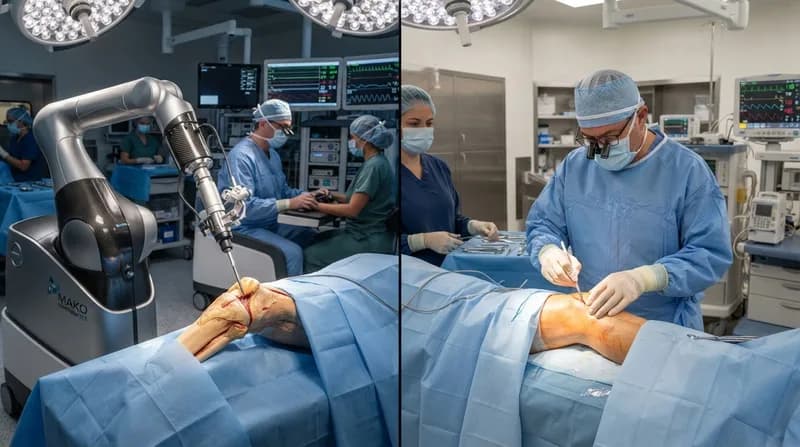
The Promise vs. The Reality
For years, robotic assistance in orthopedic surgery has been hailed as a transformative leap forward. By using specialized robotic arms, surgeons can theoretically achieve higher levels of accuracy when placing artificial knee implants, customizing the procedure to match the unique anatomy of each patient. However, a landmark clinical trial, the RACER-Knee study, has provided a sobering reality check for this high-tech medical trend.
The study, coordinated by the University of Warwick and the University Hospitals Coventry and Warwickshire NHS Trust, represents the world’s largest double-blinded, randomized controlled trial of its kind. Published in the medical journal The Lancet, the research compared traditional total knee replacement surgery against procedures performed using the Stryker Mako robotic system. While the robotic technology successfully increased surgical precision, the long-term clinical data suggests this technical edge has not yet translated into better outcomes for patients in the first year following their operation.
Understanding the Trial Findings
The trial included 339 patients treated by 33 different surgeons across 10 UK hospitals. Researchers tracked multiple metrics, including pain levels, mobility, and the "Forgotten Joint Score," which evaluates how much a patient remains conscious of their artificial knee during daily life. One year after surgery, there were no meaningful differences between the robotic-assisted group and the conventional group. Both cohorts reported similar levels of recovery and pain reduction.
Beyond clinical outcomes, the study highlighted practical concerns regarding efficiency. Robotic-assisted procedures took an average of 10.5 minutes longer to perform than traditional surgeries. Additionally, the robotic approach added approximately £950 in costs per procedure. Given these factors, the technology was not deemed cost-effective within the first year of recovery, though researchers noted that the safety profile of the robotic system is comparable to standard manual surgery, with no increased risk of serious adverse events.
Why it matters
- Precision is not enough: Higher accuracy during the mechanical phase of surgery does not automatically equate to a better biological or functional result for the patient.
- Cost-effectiveness: Currently, the added time and expense of robotic systems are not justified by improved short-term clinical benefits.
- Future potential: The study is not a condemnation of robotics, but a roadmap for improvement; surgeons may need to refine how they use this precision to better personalize patient care.
- Long-term tracking: Researchers plan to continue monitoring participants for a full decade to see if differences in revision rates or long-term mobility emerge over time.
The Path Toward Personalized Orthopedics
Despite the lack of immediate superiority, industry experts and the study authors remain optimistic about the role of robotics in the future of surgery. The consensus among the investigators is that the technology is a tool that requires further evolution. If surgeons can learn to leverage robotic precision to better address subtle individual anatomical variations, it could eventually lead to improved patient experiences.
As medical institutions continue to adopt these platforms, the focus will likely shift from simply achieving mechanical alignment to using the data provided by these systems to create truly personalized surgical plans. For now, the trial serves as a vital reminder that technological innovation in healthcare must be rigorously evaluated before it is considered a universal upgrade over established, effective surgical traditions.