The Quest for Cosmic Symmetry
For decades, physicists have wrestled with a glaring contradiction at the heart of our understanding of reality: the Big Bang should have produced equal parts matter and antimatter, yet the observable universe is almost entirely dominated by matter. If the standard cosmological models were perfectly correct, matter and antimatter would have annihilated each other upon creation, leaving behind nothing but energy. A new, landmark achievement from Northwestern University, published in Physical Review Letters, brings us closer than ever to discovering the "cracks" in the Standard Model that might explain this existential mystery.
Led by Gerald Gabrielse, a team of researchers has achieved an unprecedented level of control over a single positron, the antimatter counterpart of an electron. By capturing this elusive particle and stabilizing it within a sophisticated vacuum environment, the team has essentially created an artificial atom that can be measured and manipulated with extreme precision.
The "One-Positron Quantum Cyclotron"
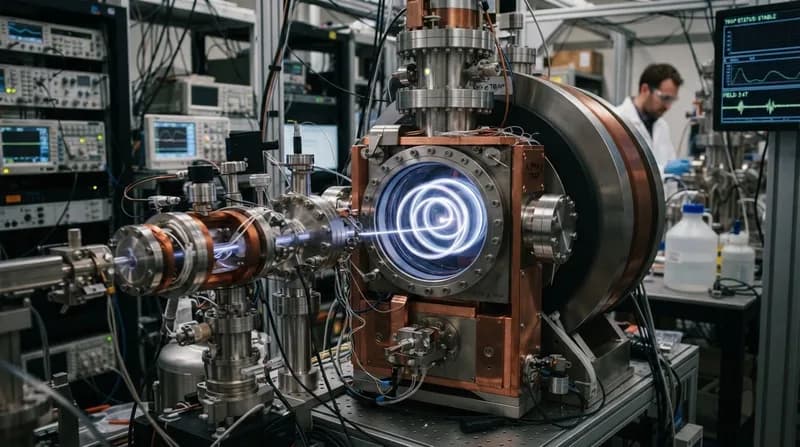
The core of this breakthrough is the development of a "one-positron quantum cyclotron." This device uses a complex array of electromagnetic fields to suspend a single positron in a perfect vacuum. Because contact with any physical surface would cause immediate annihilation, the team had to design a "wall-free" trap that isolates the particle from the environment entirely. This suspension allows the positron to be held for months, providing researchers with ample time to conduct measurements.
To get the positron to a manageable state, the team sourced the particles from the radioactive decay of sodium-22. Once captured, these high-energy positrons were drastically slowed and cooled to approximately 300 millikelvins—a mere 0.3 degrees above absolute zero. At these extreme temperatures, the positron settles into its lowest quantum ground state, allowing the team to use tuned microwaves to observe and alter its energy levels with incredible accuracy.
Why it Matters
- Refining the Standard Model: The Standard Model is remarkably accurate, but it fails to explain the cosmic dominance of matter. Precise comparisons between electrons and positrons serve as a stress test for the theory.
- Fundamental Symmetry: If a discrepancy is found between the magnetic properties of an electron and a positron, it would represent one of the most significant discoveries in physics in the last century.
- Technological Precision: This research leverages previous advancements in electron trapping and antiproton cooling, pushing the boundaries of what is possible in low-energy antimatter experimentation.
Implications for Future Physics
The ultimate goal of the Northwestern team is to conduct a direct, high-precision comparison of the magnetic properties of the trapped positron against those of an electron. Previously, Gabrielse and his team measured the electron's magnetic moment with an accuracy of one part in 10 trillion. By performing an identical, equally rigorous measurement on a positron, the team hopes to find even the slightest deviation between the two particles.
Should such a difference exist, it would signal that our current understanding of particle physics is incomplete, potentially revealing the mechanism that allowed matter to survive the aftermath of the Big Bang. While the researchers note that their experiment is not dangerous—they lack the quantities of antimatter required for any sort of energetic reaction—the implications for our understanding of the universe are vast. This work represents a masterful intersection of quantum control and fundamental cosmology, aiming to settle a debate that has puzzled scientists since the dawn of the atomic age.