An Unexpected Celestial Encounter
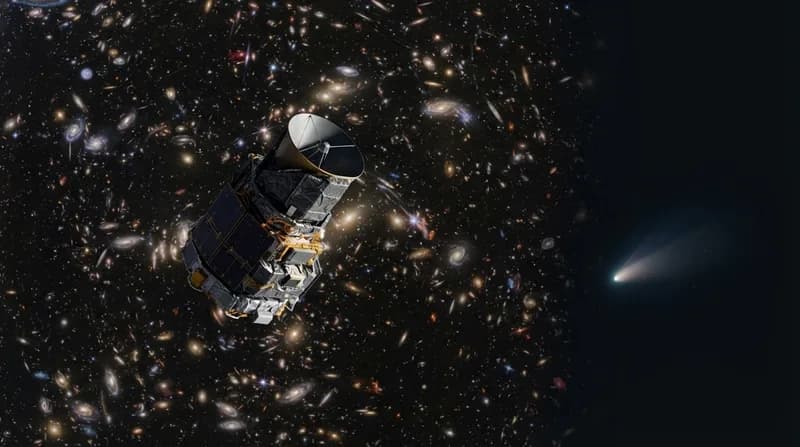
The European Space Agency (ESA) is celebrating a surprise addition to its astronomical catalog. While the Euclid space telescope is engineered to peer billions of light-years away to map the distribution of dark matter and dark energy, it recently turned its gaze much closer to home. During routine observations in the 'Euclid Deep Field North,' the mission captured evidence of a previously unknown comet, officially designated as C/2026 S1 (Euclid).
The discovery was triggered by specialized software developed by PhD student Mikko Pöntinen at the University of Helsinki. By analyzing image streaks—artifacts often considered 'noise' in deep-space photography—researchers identified the tell-tale fuzzy coma characteristic of an active, dust-shedding comet. This find is a testament to the high sensitivity of Euclid’s instruments, which successfully logged the object across five separate fields of view, totaling 16 individual exposures.
The Nature of C/2026 S1
C/2026 S1 is currently situated approximately 1.3 billion kilometers from Earth, placing it in the vast gap between the orbits of Jupiter and Saturn. Unlike the planets, which generally orbit within a relatively flat plane around the Sun, this comet follows a high-inclination path that takes it well outside the solar system's traditional alignment. Astronomers note that its orbit is extremely long, spanning thousands of years, marking it as an ancient relic from the dawn of our solar system roughly 4.6 billion years ago.
As these icy bodies approach the Sun, they undergo thermal transformation, turning frozen volatiles directly into gas. This process creates the luminous, hazy cloud and characteristic tail that allowed the Euclid team to distinguish the comet from asteroids or stationary background stars. Because these objects have remained largely undisturbed since the formation of the Sun, they act as time capsules, holding chemical signatures that may explain the origins of water and organic building blocks on Earth.
Why Euclid Typically Avoids Solar System Objects
The discovery of C/2026 S1 is an anomaly because Euclid is actively configured to avoid the solar system's plane. The telescope specifically targets regions of the sky away from the ecliptic to minimize light interference from interplanetary dust—a critical requirement for its primary mission of measuring subtle gravitational lensing caused by dark matter. Furthermore, Euclid’s 'step-and-stare' observation strategy is optimized for static galaxy mapping, making the tracking of fast-moving, transient objects like comets technically difficult.
Why It Matters
- Mission Versatility: The discovery proves that Euclid can serve as an unexpected monitoring tool for the solar system, even while conducting its primary dark universe survey.
- Inter-Agency Coordination: The successful identification and rapid reporting to the Minor Planet Center establishes a framework for future collaboration between survey telescopes and targeted missions, such as the upcoming ESA Comet Interceptor.
- Scientific Value: Comets provide a literal roadmap to the early conditions of our solar system, offering data that complements our understanding of planetary formation.
Looking ahead, while C/2026 S1 is not a candidate for a close-range flyby by current interceptor probes, the workflow established by the Euclid Consortium provides a robust template for future detections. As researchers continue to refine their algorithms to filter out 'noise' like this comet, they may find that Euclid’s legacy ends up being twofold: unlocking the dark secrets of the universe and cataloging the wandering travelers within our own cosmic backyard.