A Glacial Reversal
For millions of years, Earth’s climate has operated in a rhythmic, predictable dance of glacial and interglacial periods. However, recent findings published in the journal Science by geochemists from Columbia Climate School suggest this natural heartbeat may have been fundamentally disrupted by human activity. By analyzing ancient plant life preserved beneath the Barnes Ice Cap in the Canadian Arctic, researchers have uncovered evidence that a new ice age was already underway approximately 2,000 years ago, only to be halted by the effects of global warming.
The Laurentide Ice Sheet, which once blanketed a massive portion of North America, is largely a relic of history. While it reached its peak between 95,000 and 20,000 years ago, small remnants have persisted through the millennia. The researchers found that after reaching its smallest extent roughly 3,000 years ago, the ice began to expand again around 2,000 years ago. This expansion, they argue, marked the inception of a new glacial period—a cycle that was abruptly interrupted by warming temperatures that accelerated in the 1960s.
The Time Capsule of the Arctic
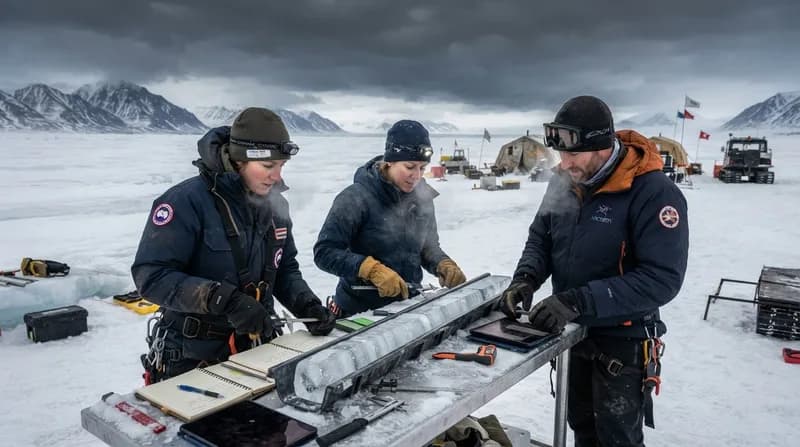
The key to this discovery lies in the unique nature of the Barnes Ice Cap. Unlike typical glaciers that scrape and churn the landscape as they move, the Barnes Ice Cap is frozen directly to the underlying bedrock. This static nature has acted as a natural preservation system, trapping vegetation in its original growth position for thousands of years. As the ice cap has retreated in the face of modern climate change, it has begun to release these botanical time capsules.
By utilizing radiocarbon dating on these unearthed plants, the team was able to pinpoint exactly when the landscape was overtaken by ice. This methodology allowed for the reconstruction of a precise timeline of glacial advancement. The data provides a rare, empirical look at the transition into a colder climate epoch, contrasting sharply with previous climate models that predicted a new ice age was still thousands of years away. Instead, the evidence suggests that the process was in its infancy until the trajectory of the planet was forcibly shifted.
Why It Matters
- Systemic Interruption: The study provides a powerful example of how human-driven climate change has moved beyond merely affecting weather patterns to fundamentally altering deep-time geological cycles.
- Positive Feedback Loops: The Laurentide Ice Sheet served as a critical catalyst for past ice ages; its impending total disappearance may remove a necessary starting condition for future cooling cycles.
- Redefining Glaciation: The research challenges current definitions of when an ice age begins, suggesting we should look at the first signs of sustained ice sheet expansion rather than waiting for continental coverage.
An Uncertain Future for Climate Cycles
The implications of this discovery extend well beyond the history books. As the Barnes Ice Cap continues to shrink—with projections suggesting it may disappear entirely in the coming centuries—the planet is losing a vital component of its historical climate mechanism. Because large existing masses of ice create conditions that favor further accumulation, the loss of this remnant could permanently change how future glaciations develop, or if they can develop at all under current atmospheric conditions.
Ultimately, the researchers underscore a sobering realization: the natural and predictable patterns that have governed the Earth for eons are no longer operating in the same capacity. The halt of this nascent ice age stands as perhaps the most significant indicator yet of the human impact on the Earth's geosphere, signaling that the planet's internal climate clock has been irreversibly altered.