The Challenge of the Blood-Brain Barrier
The human brain is protected by an incredibly sophisticated security system known as the blood-brain barrier (BBB). While this dense network of cells and tight junctions is essential for filtering out toxins and pathogens from the brain's delicate environment, it acts as a nearly impenetrable fortress against medical intervention. For decades, oncologists and neurologists have struggled to find ways to deliver sufficient doses of therapeutic drugs to the brain, as the BBB typically blocks the majority of conventional intravenous medications from ever reaching their intended site of action.
Now, a research team at the California Institute of Technology (Caltech), led by Professor Wei Gao, has unveiled a breakthrough: a system of light-activated nanorobots dubbed "BrainBots." These tiny machines are designed to bypass the traditional limitations of systemic drug delivery, offering a precise, mechanical method for ferrying life-saving treatments directly into the brain.
Design and Mechanics of the BrainBots
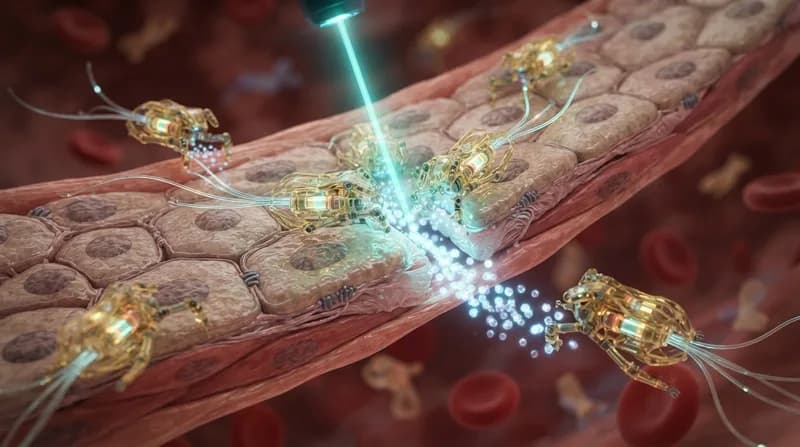
Each BrainBot measures approximately 250 nanometers in diameter—substantially smaller than the width of a human hair. The robots are constructed from biocompatible, biodegradable materials, ensuring that they do not persist in the body as harmful waste. The design is elegantly asymmetric, mimicking the structure of a tiny balloon that carries a specific therapeutic payload.
The propulsion system relies on a clever thermal-gating mechanism. Inside the robot, a chamber contains ammonium bicarbonate, which acts as a gas-generating fuel. When the nanobots are introduced into the bloodstream, they remain dormant until they reach the site of the blood-brain barrier. At this point, near-infrared light is directed through the skull, which heats the nanobot’s structure. This heat triggers a temperature-sensitive gate to open, releasing a burst of gas that propels the bot forward with increased velocity. This active movement allows the BrainBot to make direct contact with the cells lining the BBB.
Targeting and Delivery
The success of the BrainBots relies on more than just physical propulsion. The exterior of each nanobot is coated with specialized DNA molecules called aptamers. These serve as molecular "keys," allowing the bots to recognize and bind specifically to the cells that form the blood-brain barrier. Once the aptamers facilitate this connection, the BBB cells absorb the BrainBots through a natural transport process, effectively ferrying them across the barrier into the brain tissue.
Once successfully inside the brain, the BrainBots continue to degrade. As their structure breaks down, they release their medical payload exactly where it is needed most. In preclinical studies involving mouse models of glioblastoma, this approach resulted in the delivery of approximately five times more chemotherapy medication than non-activated methods. This localized treatment significantly slowed tumor growth and extended survival rates, while simultaneously reducing the systemic toxicity usually associated with high-dose chemotherapy.
Implications for Future Neurology
The success of the BrainBots in treating brain cancer is just the beginning. While the Caltech team focused on glioblastoma to demonstrate the technology's potential, the underlying platform is highly adaptable. Researchers are optimistic that this light-activated propulsion could be used to treat a wide array of neurological conditions, including Parkinson’s disease and other degenerative disorders that have long been considered untreatable due to the limitations of drug delivery.
- Precision Propulsion: Near-infrared light triggers a thermal gate to propel bots toward barrier cells.
- Biocompatible Design: The robots fully degrade, minimizing long-term risks to the host.
- Enhanced Efficacy: Studies demonstrate five times higher drug concentration in the brain compared to conventional delivery.
- Future Flexibility: The platform is designed to carry various therapeutic agents, opening doors for diverse neurological treatments.
While the team continues to refine the stability and long-term safety profile of the nanobots, the demonstration in mouse models marks a significant milestone in medical engineering. By successfully harnessing light to manipulate movement at the nanoscale, Caltech has provided a blueprint for future therapeutic strategies that could eventually overcome one of medicine's most persistent and formidable barriers.