A Quantum Twist in Plain Sight
In the world of condensed matter physics, researchers have long sought materials that can manipulate electron behavior through exotic magnetism. A breakthrough from the Max Planck Institute for Chemical Physics of Solids (MPI CPfS) in Dresden has now identified an unlikely candidate: europium silicide (EuSi). Despite being a chemically simple metal, EuSi hides a complex internal architecture that could fundamentally change how we approach electronic device design.
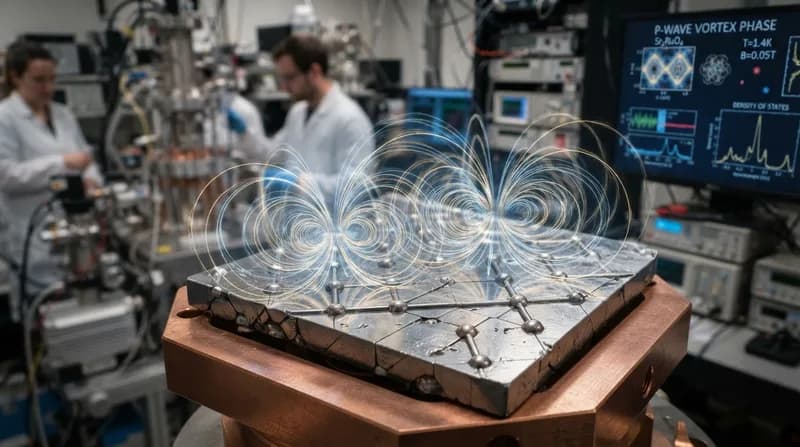
Unlike traditional magnets found on a refrigerator, which rely on ferromagnetism to generate a collective magnetic field, EuSi operates through a delicate, self-canceling dance of atomic moments. At temperatures between 33 and 62 kelvin, the europium atoms within the crystal lattice arrange themselves into a repeating spiral. Because these spirals orient in opposing directions, the material produces no net magnetization, effectively hiding its internal magnetic identity from a standard compass.
The Mechanics of P-Wave Magnetism
The true significance of EuSi lies in its 'p-wave' magnetic state. Within this structure, the orientation of an electron's spin is inextricably linked to the direction of its momentum. This phenomenon, known as an odd-parity spin texture, means that if an electron reverses its path, its spin polarization reverses as well. This creates a highly controlled environment where electron movement and spin are governed by the symmetry of the atomic spiral.
To confirm this behavior, an international team of 38 scientists employed a multi-modal approach. By utilizing neutron diffraction to map the atomic arrangement and spin-resolved photoemission spectroscopy to observe electron polarization directly, the team confirmed that the spin-flipping behavior matched theoretical predictions perfectly. They discovered that the magnetic order exerts a massive influence on the material's electronic band structure, causing energy separations exceeding 100 millielectronvolts.
Chirality and Future Applications
Beyond its spin-based properties, EuSi exhibits a curious form of 'handedness,' or chirality. Even though the material's underlying crystal lattice is centrosymmetric, the magnetic spirals can twist in either a left-handed or right-handed direction. These domains—each measuring roughly ten micrometers—act as distinct physical zones that respond differently to light. By manipulating these domains, researchers can dictate how the material interacts with electronic currents.
Why It Matters
- Spintronics Advancement: By utilizing the electron's spin rather than just its charge, EuSi could pave the way for faster, lower-energy information storage systems.
- Experimental Accessibility: Unlike previous candidates for p-wave magnetism that required extreme conditions or complex chemical compositions, EuSi is a stoichiometric metal that can be grown into high-quality single crystals.
- Quantum Foundations: This discovery provides a robust platform for testing theories on unconventional superconductivity, where electricity flows without resistance in ways that defy standard physical models.
While this research does not imply immediate commercial applications, it provides a crucial, simplified platform for experimentation. By mastering how magnetic symmetry and chirality control electron behavior, the scientific community now has a clearer roadmap to building the next generation of quantum materials that could one day render traditional silicon-based logic obsolete.