A Leap in Acoustic Manipulation
In a significant breakthrough for fluid dynamics and material handling, researchers at the University of Helsinki have successfully demonstrated a way to transport liquids through open air without the need for physical infrastructure. By utilizing advanced acoustic levitation techniques, the team has essentially created an invisible, programmable pipe, paving the way for contact-free transportation of volatile, viscous, or hazardous substances.
Traditional fluid transport typically requires pipes, channels, or microfluidic chips, all of which are susceptible to chemical corrosion, biological contamination, or physical clogging over time. By bypassing physical barriers entirely, this new ultrasonic method offers a pristine environment for handling sensitive materials, ranging from biological samples to aggressive chemical reagents, where purity and precise control are paramount.
How the Acoustic Tube Functions
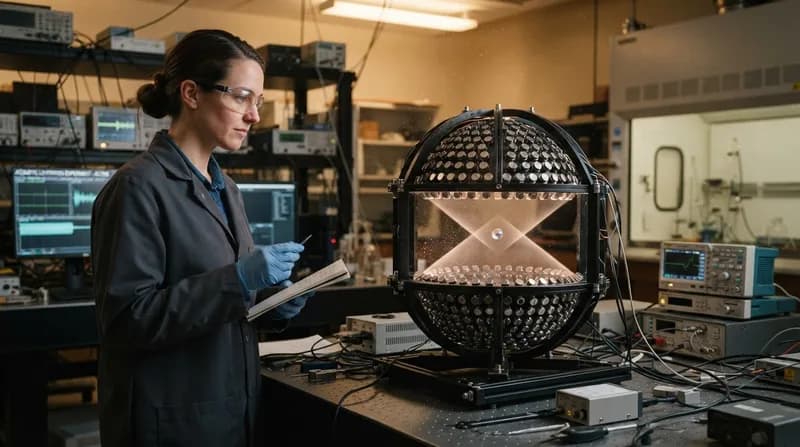
The core of this innovation relies on the generation of what researchers call elongated Bessel acoustic fields (EBAFs). By orchestrating a phased array of 256 individual ultrasonic transducers operating at approximately 40 kHz, the system creates a focused, tube-like pressure field in space. This field acts as a structural boundary, exerting radial acoustic forces that converge to trap and guide materials along a stable, defined trajectory.
Unlike previous attempts at acoustic levitation that were limited to moving single particles or isolated clusters, this EBAF-based approach allows for a continuous, laminar flow of material. Because the acoustic field is entirely generated by software-controlled hardware, the invisible "pipe" can be reconfigured in real-time. Scientists can manipulate the curvature, length, and destination of the flow simply by adjusting the phase and amplitude of the speaker array, allowing for complex, dynamic transport paths that would be impossible with rigid, stationary hardware.
Why It Matters
- Contamination-Free Transport: By eliminating physical surfaces, the risk of chemical reactions between the fluid and pipe material is completely removed.
- Flexibility and Control: The system is fully software-reconfigurable, allowing the transport trajectory to adapt to specific experimental needs without mechanical adjustments.
- Versatility: The technique is effective across multiple states of matter, including liquids, gases, aerosols, and solid particles.
- Safety: This non-contact method is ideal for handling hazardous or highly reactive materials that could endanger researchers or damage standard laboratory equipment.
As the technology matures, it holds the potential to transform fields as diverse as drug synthesis, micro-scale manufacturing, and laboratory automation. By replacing physical plumbing with sound, scientists have opened a new chapter in material transport, proving that the most efficient pathways are sometimes those we cannot even see.