The Quantum Emitter Dilemma
The promise of a quantum future—spanning everything from ultra-secure communication networks to high-performance quantum computers—hinges on our ability to control light at its most fundamental level: the single photon. Solid-state quantum emitters, such as quantum dots, nanowires, and specific atomic-scale defects, are the frontrunners for generating these photons. Unlike gaseous atoms, these solid-state structures are robust, integration-ready, and don't require the cumbersome trapping mechanisms typically found in traditional lab setups.
However, engineering these materials is only half the battle. The persistent challenge for researchers lies in verifying that a source is truly emitting single, pure photons. Simply locating a fluorescent spot under a microscope is not enough; one must confirm that the emission originates from a single, discrete source rather than a cluster of emitters. This verification process has historically been fragmented and slow, requiring multiple instruments and complex experimental workflows.
The Solira Solution: Integrated Characterization
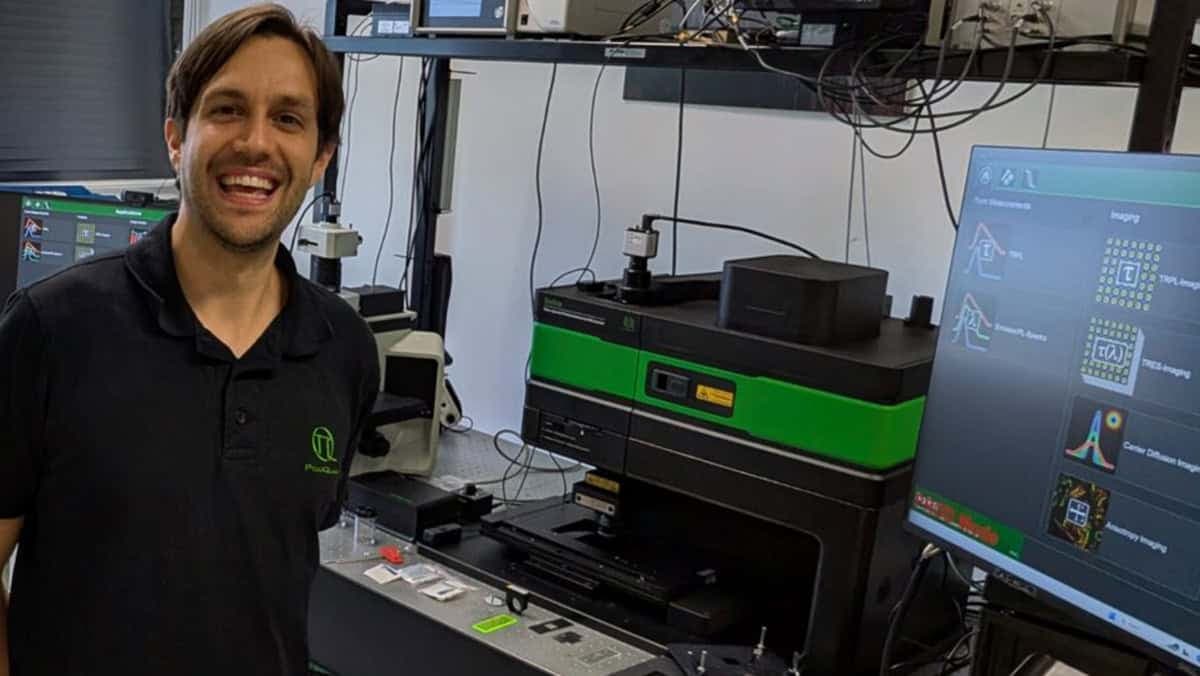
PicoQuant, the German photonics specialist, is looking to solve this bottleneck with their new Solira platform. The Solira system is a configurable upright microscope designed to consolidate the entire verification workflow into a single, cohesive process. By combining spatially resolved photoluminescence imaging with high-precision photon-correlation measurements, it allows scientists to move seamlessly from searching for a candidate emitter to proving its quantum credentials.
The system excels at validating 'nitrogen-vacancy' (NV) centers in nanodiamonds—defects in the carbon lattice that trap electrons and emit light with remarkable stability at room temperature. Because these NV centers are already considered the 'diamond standard' for calibration in quantum physics, they serve as the perfect benchmark for the Solira’s capabilities. The software-driven workflow guides the user through the process, ensuring that the transition from initial imaging to complex quantum correlation analysis is intuitive and repeatable.
Proving Single-Photon Emission via Antibunching
At the heart of the Solira’s functionality is its ability to perform second-order photon correlation measurements. This process targets a phenomenon known as 'photon antibunching,' where the suppression of coincident photon detections proves that a source is indeed emitting single photons. The system directs the light from a selected emitter through a 50:50 beam splitter towards two separate single-photon detectors. Since a single photon cannot be split between two paths, it is physically impossible for both detectors to register a hit at the exact same moment—a condition referred to as zero-delay correlation.
While perfect single-photon emission yields a correlation value of zero, real-world conditions inevitably introduce noise. However, the Solira is sensitive enough to consistently record values well below 0.5, which is the standard industry threshold for confirming a dominant single-emitter source. The system supports both continuous-wave and pulsed excitation, giving researchers the flexibility to minimize optical fatigue in sensitive materials while still gathering high-fidelity data.
Why It Matters
- Workflow Efficiency: By combining spatial imaging and temporal correlation, Solira reduces the time researchers spend switching between different experimental setups.
- Standardization: Provides a robust, repeatable methodology for characterizing new quantum materials, essential for moving from experimental prototypes to functional quantum devices.
- Multi-modal Versatility: Beyond basic antibunching, the platform supports variable temperature, light intensity, and wavelength testing, enabling comprehensive analysis of material behavior under diverse conditions.
- Accessibility: The guided software interface lowers the barrier to entry, allowing researchers to perform advanced quantum measurements without needing to manually reconfigure hardware between every step.
As the scientific community pushes to integrate quantum light sources into real-world networks and computing hardware, the role of precise, efficient characterization becomes paramount. With the Solira, PicoQuant isn't just providing a new microscope; they are establishing a standardized pipeline for the next generation of quantum materials research.