A Surprising Surge in Antarctic Mass
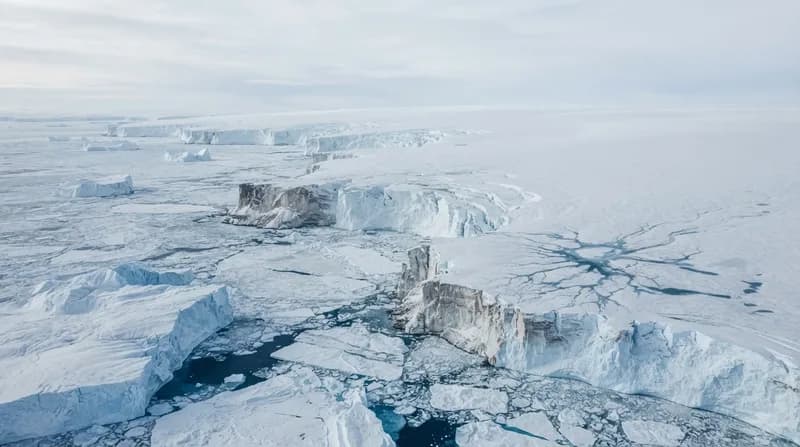
In a rare reversal of long-standing environmental trends, East Antarctica experienced an extraordinary gain of approximately 695 billion tons of ice between 2021 and 2023. This massive accumulation, detected via the GRACE satellite missions, briefly acted as a counterweight to the continent's consistent, long-term ice loss. While the Antarctic Ice Sheet generally sheds about 140.5 billion tons of mass annually, this recent anomaly marks the largest gain ever recorded by satellite monitoring, prompting a global search for the driving forces behind such a sudden shift.
Researchers from the Institute of Oceanology of the Chinese Academy of Sciences (IOCAS) synthesized gravity satellite data, historical snow records, and sophisticated atmospheric circulation simulations to unlock the mystery. Their findings indicate that the phenomenon was not a localized event but rather a cascading reaction to climatic changes originating thousands of miles away near the equator.
The Tropical Warm Pool as a Global Regulator
The study, published in the journal Nature, identifies a phenomenon known as the "tropical warm pool"—a region where the tropical western Pacific meets the eastern Indian Ocean—as the primary culprit. Sustained warming in these waters during the 2021-2023 period initiated a large-scale atmospheric disturbance known as a Rossby wave train. These planetary-scale waves act as conduits, carrying information about temperature and pressure shifts across immense distances.
This wave train reorganized the atmospheric conditions over the Southern Hemisphere, creating a distinct north-south dipole. This configuration established an unusual low-pressure zone south of Australia and a high-pressure zone along the East Antarctic coast. The resulting pressure gradient fundamentally altered the paths of atmospheric rivers, effectively funneling moisture-rich air away from the midlatitudes and directly toward the Queen Mary Land and Wilkes Land regions of East Antarctica.
Why It Matters
- Climate Connectivity: The discovery proves that tropical ocean temperatures act as a remote "regulator" for Antarctic mass balance, demonstrating how interconnected global climate systems truly are.
- Temporary vs. Structural Change: Despite the scale of this accumulation, researchers emphasize that this is a transient event. The West Antarctic Ice Sheet continues to lose mass, and the long-term trend of decline remains unchanged.
- Modeling Future Impacts: By identifying this specific "teleconnection pathway," scientists can better refine models used to predict future sea-level rise and understand how the Southern Hemisphere's weather patterns respond to equatorial fluctuations.
Distinguishing Climate Drivers
A critical aspect of this research was distinguishing between natural variability and anthropogenic influence. By examining the data, the team determined that the general increase in atmospheric moisture associated with global warming accounted for only 9% of the observed snowfall anomaly. This finding suggests that the massive ice gain was primarily driven by the specific atmospheric reorganization caused by tropical sea surface temperatures rather than a direct, uniform result of global warming.
The study provides a necessary, nuanced perspective on how Antarctica responds to a changing climate. While the continent is generally seen as a singular, melting monolith, these findings reveal a complex, reactive system capable of temporary recoveries fueled by remote oceanic drivers. Moving forward, the research team suggests that future climate studies must account for these decadal-scale tropical oscillations to provide more accurate projections of Antarctic ice-sheet health and its subsequent impact on global sea levels.