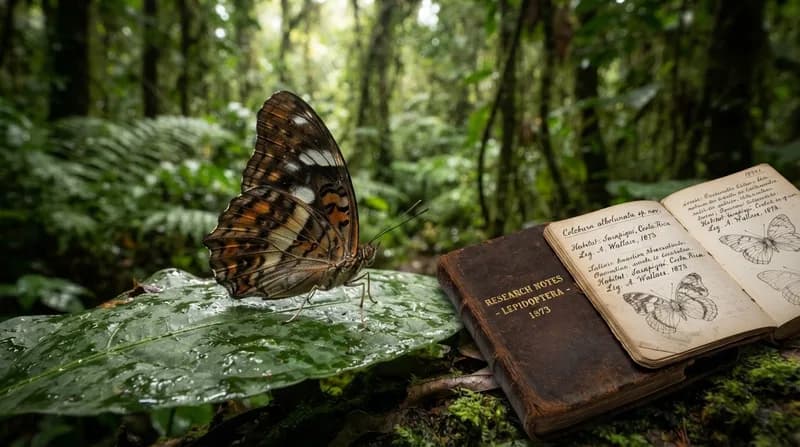
A Taxonomic Breakthrough in the Neotropics
For over two centuries, the genus Colobura has been a cornerstone of tropical butterfly observation in Central and South America. Since Carl Linnaeus first described Colobura dirce in 1758, entomologists operated under the assumption that these ubiquitous insects represented a single, widespread species. However, a team of researchers led by Anisha Sapkota at the Florida Museum of Natural History has finally dismantled this long-standing assumption, revealing that what we see as a single butterfly is actually a complex trio of nearly identical, yet genetically distinct, species.
The discovery of the third species, aptly named Colobura cryptica, was the result of a rigorous multi-year study that synthesized genomic data with previously overlooked physical traits. Despite living in the same regions and occupying the same ecological niches—specifically feeding on Cecropia trees—these butterflies have managed to maintain distinct evolutionary lineages without signs of interbreeding.
1. Colobura dirce
The original namesake of the genus, Colobura dirce, remains the most widespread of the three. Its distribution stretches impressively from Mexico through to southeastern Brazil, encompassing the Caribbean and both sides of the Andes Mountains. Anatomically, this species is identified by a gray wing stripe that widens slightly but fails to reach the yellow crossband on the underside of its wings.
Beyond the structural markings, C. dirce is further complexified by the presence of two subspecies, which exhibit differing ultraviolet reflectance values. While the species averages an ultraviolet signature of 376 nm, individual variations within the subspecies demonstrate the nuanced evolutionary path of this butterfly. Its caterpillars are characterized by distinctive cream-colored teardrop markings on their abdominal segments.
2. Colobura annulata
Recognized as a separate species only in 2001, Colobura annulata was once thought to be the final piece of the taxonomic puzzle. It covers a vast range similar to its relative, though it is notably absent from the Greater Antilles. Its wings are distinguished by a gray stripe that maintains a uniform width and terminates by meeting the yellow crossband.
The caterpillars of C. annulata offer a clearer, albeit microscopic, point of differentiation. Beneath their defensive yellow, barbed spines, they feature cream-colored ring-shaped markings. Ultraviolet analysis places this species at a distinct 370 nm wavelength, providing a biological marker that remains invisible to human eyes but acts as a clear signal for the butterflies themselves.
3. Colobura cryptica
The newest member of the genus, Colobura cryptica, is the result of persistent field observation in Venezuela. Researchers noticed that the caterpillars found in this region lacked any cream-colored markings entirely—a stark contrast to the rings and teardrops of its cousins. This observation spurred the comprehensive genomic investigation that finally defined it as a unique entity.
Physically, the adult butterfly features a uniform gray stripe that stops short of the yellow crossband. Most remarkably, it possesses a unique ultraviolet signature of 344 nm. Its geographic footprint is the most restricted of the three, spanning from southern Mexico into the Andean foothills, yet it frequently co-exists alongside C. dirce and C. annulata, deepening the mystery of how they maintain genetic isolation in the same habitat.
Why It Matters
This discovery highlights a significant gap in our understanding of neotropical biodiversity. The fact that a commonly encountered insect could evade scientific classification for 200 years suggests that many other species may currently be hidden in plain sight. Furthermore, the existence of three separate species occupying the same territory without interbreeding forces biologists to rethink the mechanisms of speciation in tropical environments, where isolation is usually considered a prerequisite for the development of new species.