Electric VehiclesTechnical Deep Dive

Tesla’s Unboxed Manufacturing: A Radical Shift in EV Production

Published
EElectricBuzz Editorial Team
Tesla’s Unboxed Manufacturing: A Radical Shift in EV Production
3 min read554 wordsElectricBuzz Editorial Team

The Gist

Tesla is revolutionizing automotive assembly with its 'Unboxed' process, a modular production technique designed to drastically shrink factory footprints and accelerate output for the new Cybercab.

The End of the Traditional Conveyor Belt

For more than 100 years, the automotive industry has relied on the linear conveyor belt—a method pioneered by Henry Ford that slowly carries a vehicle through a factory while thousands of individual parts are attached sequentially. While this system defined the 20th century, Tesla is betting that the future of electric vehicle manufacturing requires a fundamental departure from this rigid structure. With the debut of its Cybercab, the company has unveiled its 'Unboxed' manufacturing process, a strategy it claims is the first genuine revolution in car production since the early 1900s.

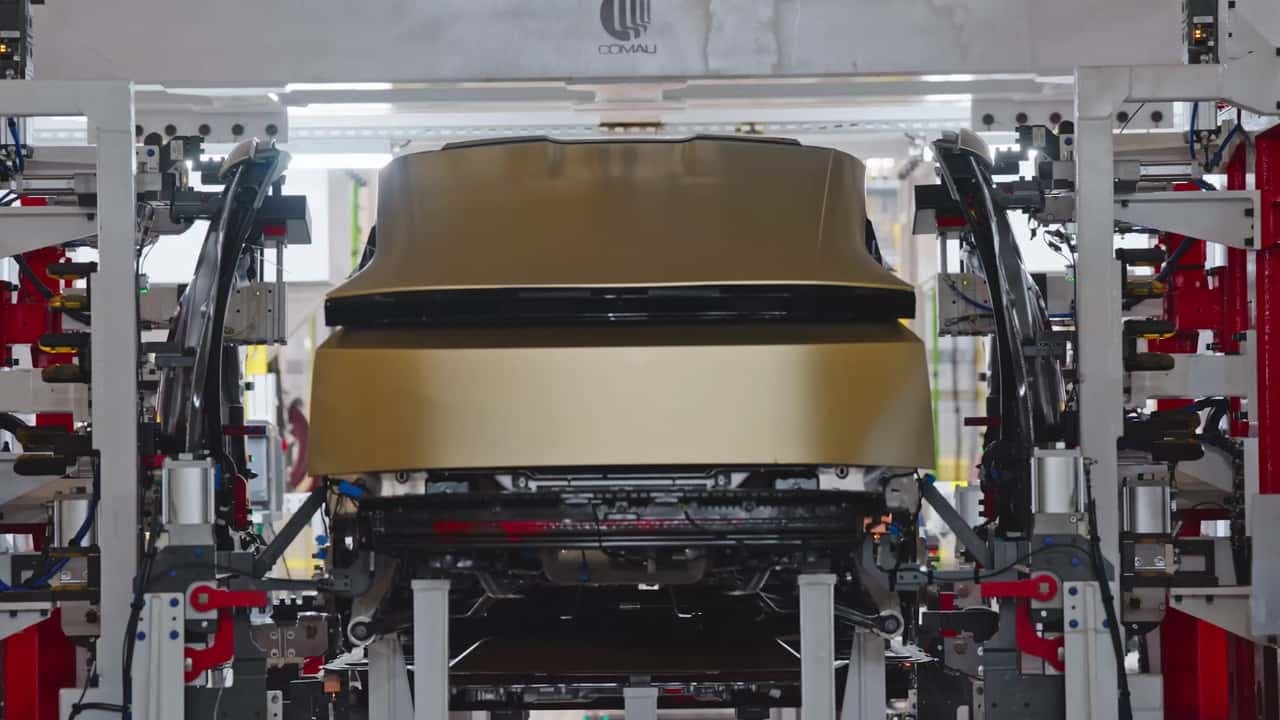
Instead of building a chassis and slowly populating it with components, the Unboxed method treats the vehicle as a set of distinct, independent modules. By manufacturing these sections on parallel lines, Tesla can assemble the car in a significantly more efficient manner. The front section, the battery housing, and the rear of the Cybercab are constructed simultaneously. It is only in the final stages of the process that these large, pre-assembled modules are brought together, with the roof, doors, and side panels added in a final integration phase.

Efficiency Through Modular Geometry

The primary advantage of this new layout is the sheer reduction in spatial requirements. Tesla reports that the Unboxed technique allows it to cut the physical size of its assembly lines by roughly 50%. This is not just a cosmetic change; it allows for vastly higher production density. By optimizing the footprint of the factory, Tesla can push more vehicles through the same square footage, lowering the overhead costs associated with massive industrial sites.

A critical enabler for this modular approach is Tesla’s mastery of mega-casting—the use of massive metal presses to create large structural components. By replacing hundreds of individual, smaller parts with a few high-precision casted sections, the assembly process becomes inherently simpler. This reduction in part count does more than just speed up the production line; it reduces the mechanical complexity, improves structural integrity, and significantly cuts down on the energy and labor required to join hundreds of separate metal components together.

Why It Matters

  • Reduced Footprint: Cutting the line length by half allows for more efficient use of real estate and lower capital expenditure for new factory builds.
  • Parallel Processing: By building modules in parallel rather than a single sequence, Tesla eliminates the bottleneck inherent in traditional long-run assembly.
  • Simplified Supply Chain: Mega-casting reduces the number of individual parts, simplifying logistics and quality control for each vehicle.
  • Industry Precedent: While Ford is also exploring modular production for its upcoming Fathom pickup, Tesla’s implementation in the Cybercab represents the first mass-production application of this philosophy.

An Outlook on the Future of Robotics and Assembly

As the automotive industry pivots toward autonomous platforms like the Cybercab, the traditional factory is increasingly looking like a relic. The transition to Unboxed manufacturing signals that the software-centric vision of the Robotaxi is being matched by an equally agile hardware strategy. By moving away from the linear, high-labor conveyor systems, manufacturers are signaling that the future of transportation will be as much about the efficiency of the assembly line as it is about the performance of the electric motors themselves. With the Cybercab already entering production, the real-world performance of these parallel assembly lines will serve as a bellwether for the rest of the EV market.
The 5 Best Over-Ear ANC Headphones of 2026, Tested & Ranked
Editor's Pick Guide
92/100
Tech & Gadgets12 min read

The 5 Best Over-Ear ANC Headphones of 2026, Tested & Ranked

We locked five over-ear ANC picks for 2026 — Sony WH-1000XM6, Bose QuietComfort Ultra 2, Soundcore Space One, Sennheiser Momentum 5, and Apple AirPods Max 2 — then stress-tested them on lab metrics, long-term owner truth, and live street prices.

Related Stories

Semantically matched articles, ranked by topic overlap and freshness.

Mercedes-Benz GLC 400 4Matic Proves Rapid Charging Trumps Range Anxiety
Electric Vehicles

Mercedes-Benz GLC 400 4Matic Proves Rapid Charging Trumps Range Anxiety

A recent long-distance road trip demonstrates that high-speed charging infrastructure and efficient battery management can make electric vehicle travel as convenient as a traditional gas-powered journey.

Porsche Closes the Loop on EV Sustainability with Innovative Battery Recycling
Electric Vehicles

Porsche Closes the Loop on EV Sustainability with Innovative Battery Recycling

Porsche is pioneering an end-to-end circular economy for electric vehicle batteries, successfully demonstrating a process to transform end-of-life cells into high-performance materials for future cars.

The Price Gap Closes: Are EVs Finally Reaching Parity with Gas Cars?
Electric Vehicles

The Price Gap Closes: Are EVs Finally Reaching Parity with Gas Cars?

New data shows the price difference between electric vehicles and combustion cars is at its narrowest point yet, signaling a shift toward organic market growth.

Hyundai Shifts Gear: Leveraging Robotaxi Fleets to Combat EV Market Volatility
Electric Vehicles

Hyundai Shifts Gear: Leveraging Robotaxi Fleets to Combat EV Market Volatility

As consumer EV demand fluctuates, Hyundai is aggressively pivoting toward the commercial autonomous vehicle sector, committing to mass-producing tens of thousands of Ioniq 5 robotaxis.

Tesla Sparks European Freight Revolution with Massive Megacharger Deployment
Electric Vehicles

Tesla Sparks European Freight Revolution with Massive Megacharger Deployment

Tesla is preparing for the European debut of its Semi truck by announcing a massive rollout of over 100 high-power Megachargers across key regions.

Congress Pushes to Mandate AM Radio in All New Electric Vehicles
Electric Vehicles

Congress Pushes to Mandate AM Radio in All New Electric Vehicles

A new bill passed by the House aims to force automakers to include AM radio tuners in all new vehicles, reigniting a debate over electromagnetic interference in modern EV design.

Delivan Launches Aggressive UK Expansion with New Electric Van Lineup
Electric Vehicles

Delivan Launches Aggressive UK Expansion with New Electric Van Lineup

Chery’s commercial vehicle brand, Delivan, is gearing up for a major European entry, targeting over 100 UK dealerships with a versatile, tech-forward electric van platform.

Volvo’s Massive Battery Upgrade Redefines the Plug-In Hybrid Experience
Electric Vehicles

Volvo’s Massive Battery Upgrade Redefines the Plug-In Hybrid Experience

Volvo is pushing the boundaries of the plug-in hybrid segment with new 2027 model-year SUVs, boasting massive batteries that deliver up to 200 km of pure electric range.