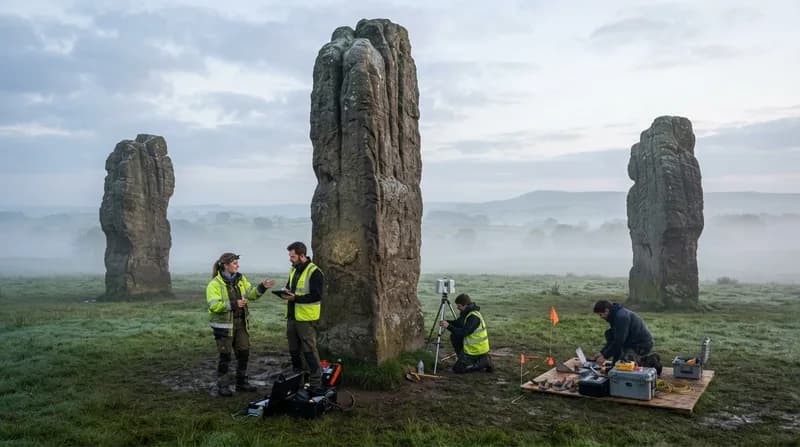
An Engineering Marvel of the Neolithic Age
The Devil’s Arrows, a collection of towering stone sentinels located near Boroughbridge, Northern England, have long stood as a testament to the enigmatic capabilities of prehistoric societies. Reaching heights of up to seven meters (23 feet), these monoliths are the tallest surviving prehistoric stone row in Britain. For years, their origin remained a subject of intense academic speculation, with many assuming the heavy stones were sourced from relatively nearby sites. However, a landmark study led by Curtin University, in collaboration with the University of York, has finally decoded the geological mystery behind these massive structures.
By utilizing a sophisticated, low-impact sampling method involving specialized adhesive tape, researchers were able to collect microscopic mineral grains from the stones without causing physical damage. This technique allowed the team to create a geological "fingerprint" of the stones, which was then compared against potential sites in the region. The findings were definitive: the Devil’s Arrows originated from Brimham Rocks, a rugged, distinct landscape located at least 18 kilometers (11 miles) away. This revelation fundamentally changes our understanding of the logistical prowess possessed by Late Neolithic or Early Bronze Age civilizations.
Challenging the Narrative of Convenience
The discovery that each of the 25-tonne (55,000-pound) stones was transported over such a significant distance carries profound implications. Previously, experts had speculated that builders would have favored the most convenient or closest sources, such as Plumpton Rocks. The fact that they bypassed closer alternatives in favor of the more distant, difficult-to-navigate terrain of Brimham Rocks suggests that the project was not merely a matter of utility, but one of deep cultural or spiritual intent.
The effort required to coordinate the extraction, transportation, and vertical installation of such massive objects indicates a high level of societal organization and engineering sophistication. The research posits that the landscape of Brimham Rocks may have held symbolic weight, driving ancient communities to undertake the grueling task of moving these stones to the site where they stand today. This deliberate choice highlights a complex belief system where the origin of the material was likely just as important as the monument itself.
Future Implications for Archaeological Research
This breakthrough marks a significant advancement in non-invasive archaeological technology. By demonstrating the efficacy of mineral fingerprinting on standing stones, the team at Curtin University has paved the way for a new, nondestructive era of investigation. The researchers plan to apply these methods to other mysterious monuments across the United Kingdom, potentially uncovering further links between prehistoric human activity and the surrounding environment.
The study also opens the door for targeted excavations at both the source location and the monument site, which could provide clues regarding the specific transport methods—such as sleds or rollers—used by these ancient engineers. As researchers continue to bridge the gap between geological science and archaeology, the story of the Devil’s Arrows stands as a powerful reminder of the ambition and ingenuity that shaped the landscape of ancient Britain.