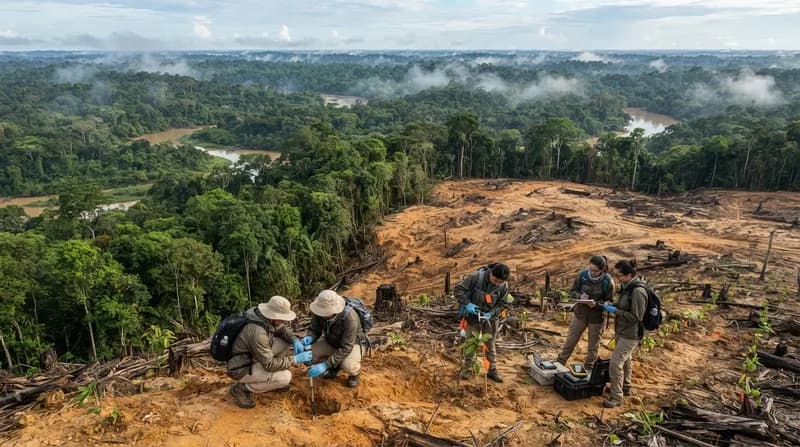
The Shift in Conservation Strategy
For years, the global conversation around tropical conservation has been dominated by two pillars: halting deforestation and restoring cleared land. However, a comprehensive study published in the journal Science suggests that these strategies may be missing a critical middle ground. Researchers from an international team led by Lancaster University have identified that protecting existing, standing forests from degradation—specifically wildfires and selective logging—delivers the most significant returns for both biodiversity and carbon storage.
The study, which tracked over three million hectares in Brazil’s Pará state between 2010 and 2020, challenges the efficiency of current conservation spending. By analyzing high-resolution satellite imagery alongside field observations of hundreds of bird and tree species, the team modeled various environmental outcomes. They found that while reforestation is vital, it is often a reactive, expensive, and less effective measure when practiced in isolation.
The Critical Need to Halt Degradation
Preventing forest disturbances was identified as the "secret weapon" of effective conservation. The researchers found that efforts to mitigate wildfires and control logging within primary forests provided biodiversity gains that dwarfed restoration projects. Furthermore, these protective measures proved almost as effective as preventing outright deforestation when it came to maintaining forest carbon stocks.
The timing of these findings is particularly urgent. With the 2026 El Niño intensifying, the Amazon’s “arc of deforestation” faces longer, hotter, and more volatile dry seasons. Under these conditions, standing forests are increasingly vulnerable to fire. The researchers argue that policy must pivot toward rapid intervention strategies that stop degradation before it necessitates expensive ecological recovery.
Why Restoration Cannot Stand Alone
While the study advocates for the protection of standing ecosystems, it does not suggest abandoning restoration. Instead, it argues that restoration is best viewed as a secondary layer of a larger strategy. In regions where significant clearing has already occurred, restoring agricultural land is essential. However, the study warns that pouring resources into planting new trees while simultaneously allowing existing forests to be degraded is akin to “pouring money into a leaky pot.”
The researchers emphasize that the most robust gains in biodiversity and carbon sequestration were only achieved through a holistic approach: combining the prevention of deforestation, the prevention of degradation, and targeted restoration. To achieve these outcomes, the team calls for a paradigm shift where commodity markets—specifically those linked to soy and beef production—take accountability for the health of the forests that remain, rather than focusing solely on areas that have already been cleared.
Why it Matters
- Cost-Efficiency: Protecting existing biomass is substantially cheaper and more productive for carbon sequestration than attempting to grow new forest ecosystems.
- Biodiversity Preservation: Intact primary forests provide habitat structures that man-made restoration projects struggle to replicate for decades.
- Policy Integration: Governments are urged to stop treating reforestation and protection as separate agendas, as they are intrinsically linked in the fight against climate change.
- Supply Chain Accountability: The responsibility for forest health extends to the global markets and industries that benefit from land-use commodities.