A Fresh Contender in a Crowded Field
The mid-size electric SUV market has arguably become one of the most monotonous segments in the automotive world. Dominated by the ubiquitous Tesla Model Y and an influx of nearly identical designs from various manufacturers, the landscape is crying out for genuine variety. Rivian, the California-based startup that made its name with the R1T and R1S, is stepping into the fray with its new R2. At 4.72 meters in length, the R2 is specifically sized to go head-to-head with heavy hitters like the Ford Explorer, BMW iX3, and the segment-leading Model Y, offering a distinct aesthetic that blends outdoor utility with modern, clean styling.
Beyond its exterior appeal, the R2 serves as the launchpad for a significant leap in electronic architecture. Through a high-profile partnership with Volkswagen—bolstered by a multi-billion dollar investment—the R2’s tech stack is set to become the backbone for future VW electric vehicles. This includes an intuitive user interface, haptic-feedback "Halo" rotary dials, and a sophisticated sensor suite comprising eleven cameras and five radar sensors. This hardware allows for advanced driver-assistance systems that manage highway navigation with minimal human intervention, with plans for autonomous city driving already in the development pipeline.
Adventure-Ready Utility and Design
Rivian distinguishes itself by leaning into an "outdoor-first" brand identity that feels rugged yet refined. The R2 is packed with clever design touches, such as a built-in flashlight in the driver’s door and a carabiner-style key fob. Functionality remains a priority; despite its smaller footprint compared to the R1 series, the R2 offers a versatile 147-liter front trunk (frunk) and an impressive total storage capacity exceeding 2,000 liters. A standout feature is the rear window, which fully retracts to accommodate long gear like surfboards or lumber, bridging the gap between urban convenience and weekend adventure.
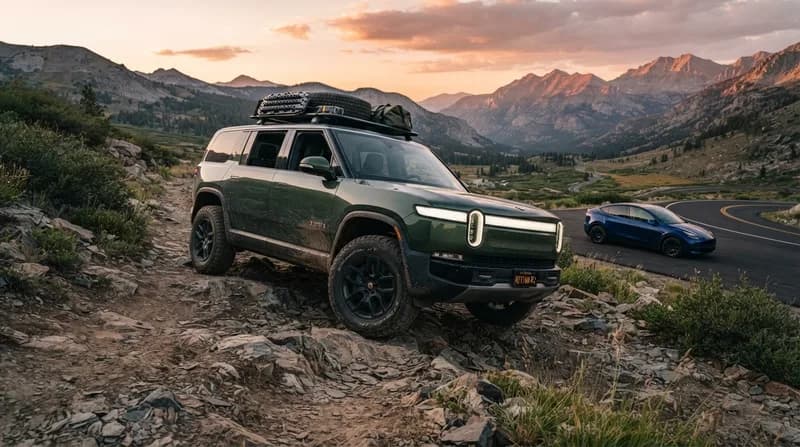
Its off-road credentials are equally surprising for a vehicle of this class. With a ground clearance of 24.4 centimeters and robust approach and departure angles, the R2 is built to handle terrain that would stop a traditional crossover in its tracks. The vehicle features specialized drive modes for conditions ranging from soft sand and snow to rally-style performance, all while maintaining a comfortable, quiet cabin environment that effectively dampens the harshness of urban potholes.
Performance and Pricing Strategy
The R2 is hitting the market with a tiered lineup to accommodate different needs and budgets. The Performance version, which leads the charge, boasts a dual-motor setup delivering nearly 490 kW and 826 Nm of torque, enabling a 0-100 km/h sprint in just 3.6 seconds. For those looking for more utility or lower entry costs, Rivian plans to roll out Premium models, a Long Range rear-wheel-drive configuration, and a base model that brings the starting price down to approximately $44,990.
While the performance is top-tier, the R2’s charging capabilities offer a modest profile compared to some of the industry’s faster-charging standards. The ~90 kWh battery pack supports a peak charging rate of just over 200 kW. While this is sufficient for daily use and current infrastructure, it may face stiff competition as other automakers move toward 800V architectures and higher peak charging speeds. Nevertheless, with vehicle-to-load (V2L) capabilities allowing the R2 to act as a mobile power bank, it remains a compelling, high-tech alternative to the current EV establishment.