A New Frontier for Battery Innovation
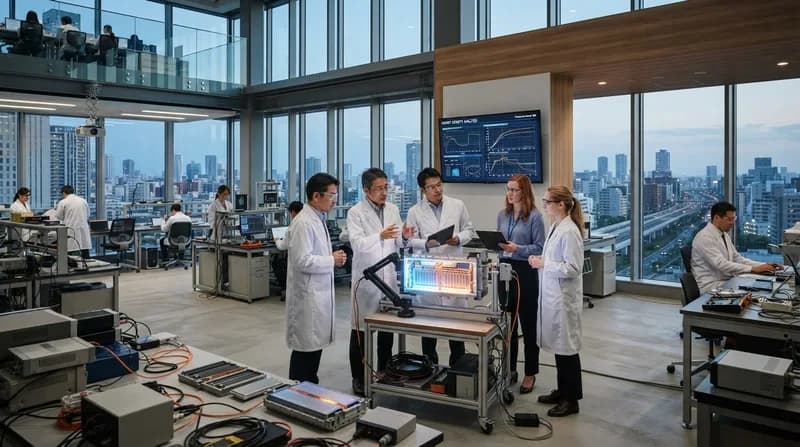
Panasonic Energy has officially opened the doors to its new "Energy Innovation Square," a state-of-the-art research and development facility located in Kadoma, near Osaka, Japan. This facility is designed to serve as a central nexus for the entire battery lifecycle—from the inception of advanced materials and cell design to the rigorous construction and analysis of prototypes. By consolidating these disparate processes under one roof, Panasonic is making a strategic play to accelerate the evolution of lithium-ion technology.
The scale of the initiative is significant. The facility houses approximately 500 dedicated employees, and when integrated with the nearby Suminoe production development site, the two locations form one of Japan’s most formidable battery innovation clusters, boasting a combined workforce of roughly 800 professionals. The synergy between these sites is intentional, aimed at bridging the often-wide gap between laboratory-based research and the realities of large-scale manufacturing.
Why it Matters: Doubling Down on Efficiency
The core objective of the Energy Innovation Square is to drastically improve development efficiency. Panasonic has set a bold target: by the end of fiscal year 2031, it aims to double its development efficiency compared to 2024 levels. A critical component of this strategy involves reducing development cycles by more than 15 percent, largely by cutting out the logistical friction of moving prototypes and data between fragmented locations.
Furthermore, Panasonic is pivoting toward a digital-first development cycle. By leveraging sophisticated simulation data alongside physical test results, the company plans to utilize advanced statistical methods to refine its cell chemistry and production parameters. This data-driven approach is expected to significantly reduce the "time to market" for new battery chemistries, which are increasingly vital for the company's aspirations in the electric vehicle and high-performance computing sectors.
Technical Focus and Market Implications
- Automotive Growth: Future cell development is squarely aimed at increasing energy density and extending the operational lifespan of EV batteries.
- AI Infrastructure: The facility is also prioritizing battery solutions for data centers, acknowledging the surging power requirements driven by global artificial intelligence expansion.
- Global Integration: Breakthroughs discovered in Osaka are designed to be exported directly to Panasonic’s manufacturing hubs, including its major plants in Nevada and Kansas, ensuring rapid global deployment.
The move comes at a pivotal time for the Japanese manufacturing giant. With recent market data showing Panasonic holding a 3.7 percent share of the global EV battery market—trailing major competitors like CATL and BYD—the Energy Innovation Square represents a vital attempt to regain competitive ground. By tightening the feedback loop between design and mass production, Panasonic hopes to not only match the pace of its rivals but to set a new standard for performance and efficiency in next-generation battery architecture.