Closing the Loop in Covington
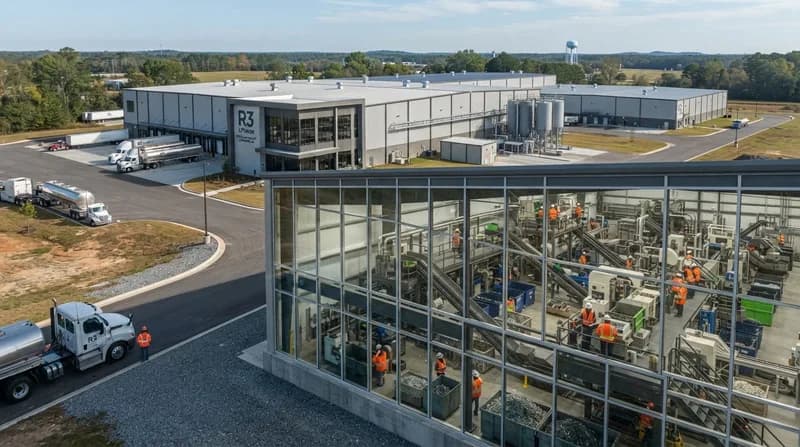
The quest for a sustainable domestic battery supply chain in the United States took a significant step forward this week as R3 Lithium transitioned its Covington, Georgia facility to continuous commercial operation. Located in a 14,300-square-meter site formerly operated by Ascend Elements, the plant is poised to become a critical pillar in the North American circular economy for electric vehicle batteries. R3 Lithium has committed an initial $15 million in Series A funding to upgrade the infrastructure, which is specifically engineered to extract high-purity lithium carbonate from recycled battery feedstocks.
The facility utilizes a sophisticated multi-stage recycling process. At its core, the plant features shredding lines with an annual capacity of 30,000 tonnes, capable of processing both production scrap and end-of-life battery packs into high-value black mass. Through a proprietary combination of calcination-based crystallization and water-based precipitation, R3 Lithium effectively isolates lithium carbonate. Beyond lithium, the plant is also designed to manage the remaining secondary materials, including nickel, cobalt, manganese, and graphite, which are marketed as distinct commodity streams.
Scaling for a Lithium-Dependent Future
With an current annual production capacity of 2,500 tonnes of lithium carbonate, the Covington site is already generating product with 99 percent purity. The company is already planning for expansion, with designated space for a second production line of equivalent size. While R3 Lithium has not provided a firm timeline for this expansion, the move signals an aggressive stance on capturing market share in the rapidly growing EV minerals sector.
Why It Matters
- Supply Chain Resilience: By focusing on recycled material rather than raw extraction, R3 reduces reliance on international mining operations.
- Economic Scale: The company has already secured significant commercial confidence, boasting offtake agreements totaling approximately one billion dollars, including a partnership with major commodity trader Trafigura.
- Technical Hurdles: The primary challenge moving forward is achieving consistent economic output. Because black mass varies significantly in quality depending on cell chemistry and battery age, R3 must prove that its chemical processes can maintain high purity levels under continuous, high-volume production.
R3 Lithium’s ambitions are grand, with the company aiming to provide more than half of the domestically produced lithium carbonate in the U.S. by 2027. While this goal highlights the current scarcity of domestic lithium processing, it also places significant pressure on the Covington plant to prove that its recycling methodology is not just technically viable, but economically sustainable at scale. As the industry watches, the success of this facility could pave the way for a network of similar plants across North America and Europe, fundamentally changing how the battery sector handles its end-of-life waste.