Outrunning the Vortex
Superconductors represent one of the most intriguing frontiers in modern physics, offering the promise of electricity flowing without resistance. Yet, their efficiency has historically been capped by a phenomenon known as the critical current. In traditional direct-current (DC) experiments, reaching this limit is nearly impossible because of the emergence of magnetic vortices. As current intensity climbs, these vortices begin to move through the material, generating heat and electrical resistance that effectively collapses the superconducting state long before it reaches its true, microscopic potential.
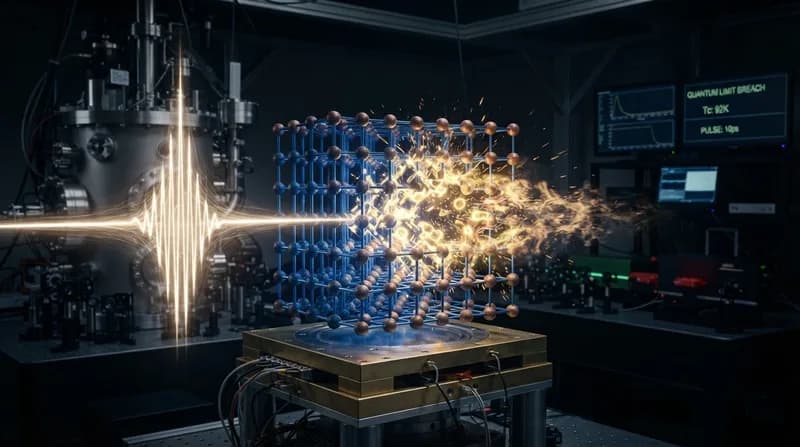
A team of researchers at the Max Planck Institute for the Structure and Dynamics of Matter (MPSD) has successfully bypassed this bottleneck by using a novel ultrafast electrical transport platform. By delivering current in extremely short bursts lasting only a few picoseconds, the scientists effectively 'outran' the vortex dynamics. Since magnetic vortices require time to traverse the material, these ultra-short pulses allow the current to reach the material's fundamental depairing limit—the point where the Cooper pairs that facilitate superconductivity physically break apart—before the vortices have a chance to destabilize the system.
Precision Engineering at the Picosecond Scale
The breakthrough was made possible by an innovative experimental setup that utilizes photoconductive switches triggered by 300-femtosecond laser pulses. When hit with green light at a 515-nanometer wavelength, these switches discharge electrical pulses of extreme brevity. These pulses are then directed into micrometers-wide superconducting samples via coplanar waveguides, allowing for unprecedented control over quantum states.
Why it Matters
- Fundamental Insights: The technique allows researchers to probe the symmetry of the superconducting energy gap, a property previously obscured by slow-acting thermal effects.
- Quantum Control: Understanding the depairing current provides a blueprint for managing stability in high-performance quantum circuits.
- Material Differentiation: The study revealed that materials like NbN and YBCO react to high currents in vastly different ways, highlighting the role of internal atomic geometry in superconductivity.
Divergent Behaviors in Quantum Materials
The research team put this technique to the test by comparing two different types of superconductors: Niobium Nitride (NbN) and Yttrium Barium Copper Oxide (YBCO). The materials exhibited markedly different thresholds, providing the scientists with a window into their distinct microscopic architectures. NbN maintained its integrity until it hit a sharp, defined threshold, after which the superconductivity collapsed instantaneously. This aligns with its uniform s-wave energy gap structure.
Conversely, YBCO displayed a more gradual degradation as current increased. This progressive weakening is attributed to its d-wave structure, where the energy gap varies significantly in different directions and vanishes in others. This behavior confirms that the microscopic structure of a material dictates how it handles intense electrical stress. By operating on timescales comparable to the quantum state itself, this new methodology provides a transformative tool for investigating quantum materials, paving the way for advancements in optoelectronics and next-generation magnetic devices.