A New Frontier in Quantum Physics
In the rapidly evolving world of material science, a team of researchers at the University of Chicago's Pritzker School of Molecular Engineering has unveiled a discovery that challenges our fundamental understanding of electron behavior. By investigating the layered magnetic material Fe5GeTe2, the team identified a unique quantum state where vast swarms of electrons move in a synchronized, ultra-slow rhythm while maintaining quantum coherence. This phenomenon, which deviates significantly from existing theoretical models, offers a fresh perspective on how we might manipulate electronic states for future technological applications.
The research, recently published in Science Advances, centers on a class of materials known as van der Waals magnets. Because these materials can be scaled down to atomically thin layers, they have long been a focal point for researchers aiming to develop memory technologies that are more efficient and compact than those currently found in modern consumer devices.
The Mechanism of Collective Synchronicity
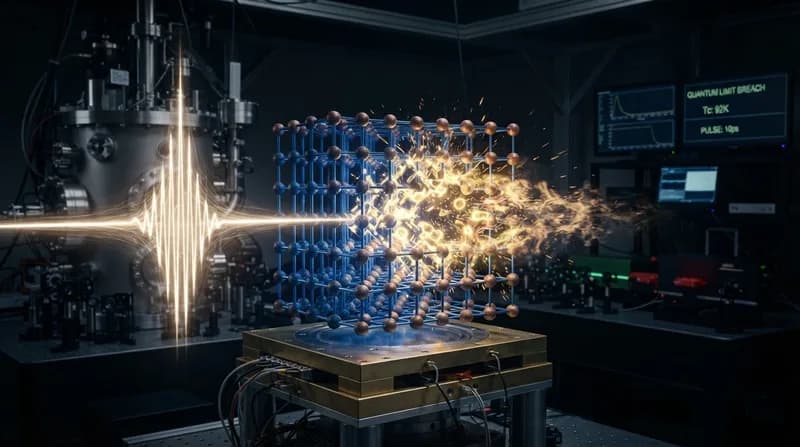
To examine Fe5GeTe2, the team utilized angle-resolved photoemission spectroscopy (ARPES), a sophisticated technique that employs ultraviolet lasers to eject electrons from the material's surface, mapping their energy and momentum. During these tests, the scientists observed a 'flat electronic band.' In physics, a flat band indicates that the kinetic energy of electrons is suppressed, causing them to move at a significantly reduced pace compared to standard conditions.
Unlike measuring a single electron, this state reveals a many-body phenomenon where millions of electrons interact and move in lockstep. Prof. Shuolong Yang, who led the investigation, likened the movement to water flow—where a gentle, shallow slope results in a sluggish, steady stream rather than a fast-moving cascade. This collective movement is not just a scientific curiosity; it suggests that the magnetic interactions governing the material are fundamentally different from what was previously theorized.
Why It Matters
- Memory Innovation: The ability to toggle the material between these quantum states using lasers could lead to the development of non-volatile memory devices that are faster and more energy-efficient than current silicon-based storage.
- Theoretical Shift: The discovery forces a complete re-evaluation of current magnetic interaction theories, providing a more accurate foundation for future quantum material research.
- Temperature Resilience: While many exotic quantum states are only stable near absolute zero, this effect persists up to 100 Kelvin. While still cryogenic, this is significantly warmer than many comparable phenomena, offering a more realistic path toward eventual room-temperature integration.
Path Toward Practical Application
The implications for the tech industry are profound, particularly regarding the future of spintronics and high-density memory. Because Fe5GeTe2 can exist in multiple magnetic configurations, the potential to 'switch' these states using a precise laser burst suggests that the material could serve as a high-speed, rewriteable memory medium. By leveraging this quantum 'slow motion' effect, researchers hope to build components that process information with minimal energy leakage.
The team is now pivoting their research to determine if these properties hold steady when the material is exfoliated into a single atomic layer. If successful, the move from bulk material to 2D monolayers could be the catalyst needed to transition this discovery from the lab bench into the next generation of computing architecture. This study, dedicated to the memory of the late physicist Peter Littlewood, stands as a testament to the ongoing exploration of quantum many-body physics and its capacity to reshape our technological future.