The Quantum Elevator
In the microscopic world, rules often defy our everyday intuition. Physicists have long grappled with the Landau-Zener-Majorana transition, a quantum phenomenon where particles appear to vanish from one energy state and instantaneously reappear in another. Imagine stepping into an elevator on the first floor and, without passing through the levels in between, arriving directly on the twentieth floor. While this is physically impossible in our macroscopic world, it is precisely what researchers have now observed occurring within the atomic structure of graphene.
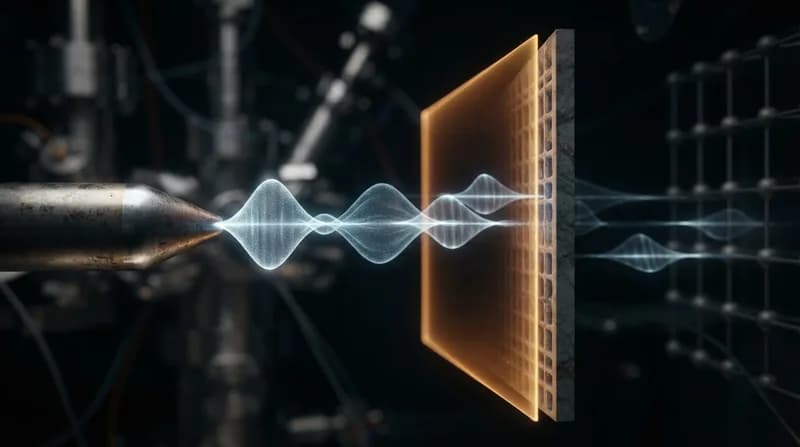
A collaborative team from the University of Regensburg, Philipps-Universität Marburg, and Forschungszentrum Jülich has successfully recorded these movements in real-time. By subjecting graphene—a single-atom-thick layer of carbon—to intense pulses of light, the team forced electrons to cross 'forbidden' energy gaps, regions where they normally cannot exist. The experiment resulted in a transition probability of 100%, meaning the electrons navigated these gaps with perfect efficiency under the right conditions.
Why It Matters: The Future of Ultrafast Tech
This discovery transcends theoretical physics, offering a roadmap for the next generation of consumer electronics. Current silicon-based technology relies on electrical voltages that are limited by how quickly electrons can be switched and moved. By mastering light-controlled electron manipulation, scientists could potentially develop hardware that operates at the speed of light, bypassing the thermal and physical constraints of conventional semiconductor architectures.
- Precision Materials: The experiment utilized ultra-pure, 'rotated' graphene from Forschungszentrum Jülich, essential for preventing imperfections from masking delicate quantum dynamics.
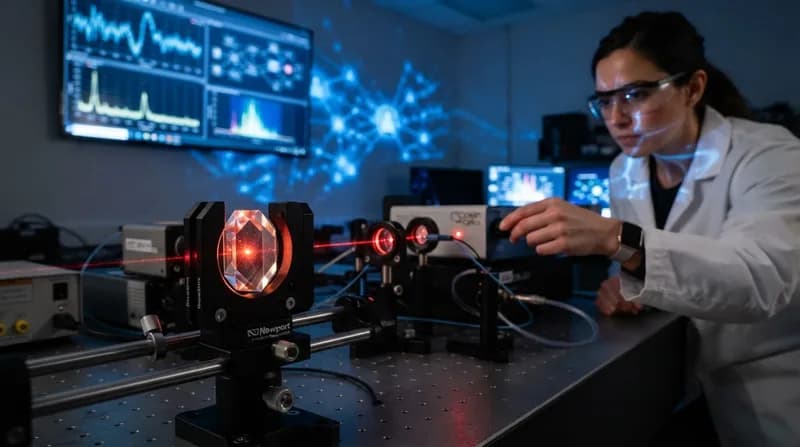
- Real-Time Observation: Researchers combined advanced laser technology with photoemission momentum microscopy, acting as a 'slow-motion camera' for quantum events.
- Light-Driven Control: By using the electric fields generated by high-speed light oscillations, scientists moved electrons across energy bands that were previously considered inaccessible.
A New Window Into Quantum Dynamics
The implications for this technology are vast. The researchers noted that while electrons initially follow orderly paths, their interaction with the material's crystal lattice eventually introduces interference. By understanding these interactions, scientists can refine how we manipulate matter at the quantum level. The goal is to move beyond simple electrical signals and create systems where light itself directs the movement of electrons with near-perfect reliability.
Beyond graphene, the research team believes their experimental technique—the ability to monitor electron movement across an entire energy landscape in real-time—is highly scalable. This 'panoramic window' into the quantum world will likely be applied to a variety of other quantum materials, potentially unlocking new pathways for quantum computing, ultrafast signal processing, and highly efficient electronic components. As the team continues their work, this fundamental breakthrough stands as a milestone in our ability to harness the strange, fast-paced nature of the quantum realm to power the devices of the future.