The Fundamental Uncertainty of Time
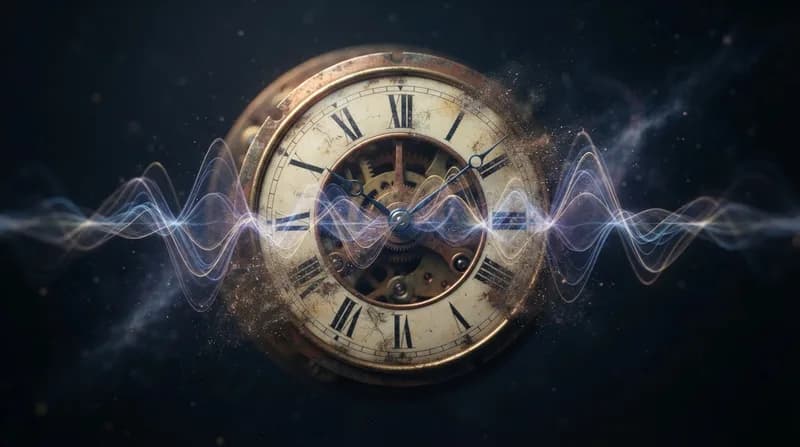
For decades, physicists have grappled with a core incompatibility in our understanding of the universe: the divide between quantum mechanics and Einstein’s general theory of relativity. While quantum theory masterfully explains the behavior of subatomic particles, general relativity dictates the motion of massive bodies and the structure of spacetime. A team of international researchers, supported by the Foundational Questions Institute (FQxI), has now bridged these two worlds with a provocative new hypothesis suggesting that time itself is not perfectly precise.
The study, published in Physical Review Research, explores the implications of "quantum collapse models." Unlike standard quantum mechanics, which posits that a wave function collapses only when measured by an observer, these models suggest that this collapse occurs spontaneously. By linking these collapse phenomena to the influence of gravity, researchers led by PhD student Nicola Bortolotti discovered that this interaction introduces a tiny, intrinsic amount of uncertainty into the flow of time.
The Diósi-Penrose and CSL Models
The research team focused their analysis on two primary frameworks to understand how these "glitches" in time manifest. The first is the well-known Diósi-Penrose model, which theorizes that gravity itself acts as a trigger for quantum systems to collapse into definite states. By mathematically modeling this, the researchers were able to project what such a phenomenon would mean for the stability of temporal measurements at a fundamental level.
The second framework investigated was the Continuous Spontaneous Localization (CSL) model. In this approach, the team successfully established a quantitative link between spontaneous collapse and gravitational fluctuations within the fabric of spacetime. This mapping allowed the researchers to derive a concrete, testable limit on how precisely any clock—no matter how advanced—can theoretically measure the passage of time.
Why It Matters
- Resolving the Quantum-Gravity Mismatch: By treating time as a variable influenced by quantum collapse rather than a fixed classical parameter, this research offers a potential pathway toward a unified theory of quantum gravity.
- Redefining Precision: While current technology is nowhere near sensitive enough to detect these fluctuations, the discovery suggests that there is a physical "floor" to clock precision that no amount of engineering can bypass.
- Experimental Feasibility: Because these collapse models predict measurable physical effects, they move the conversation from abstract philosophy to testable science, providing a roadmap for future high-precision experiments.
The Outlook for Timekeeping
Despite the discovery of this "glitch," the researchers were quick to offer a reassuring conclusion for modern society: our current timekeeping infrastructure is entirely secure. The level of uncertainty predicted by the models is infinitesimally small—far below the detection threshold of today’s most sophisticated atomic clocks. The findings do not suggest that time is "broken," but rather that it possesses a grainy, quantum-mechanical texture at the most fundamental level of reality.
Looking forward, this work serves as a critical bridge in fundamental physics. By asking what happens when we stop treating time as an immutable external parameter and start viewing it as a dynamic element of quantum-gravity interactions, scientists are opening doors to questions that have remained unanswered since the inception of relativity. As experimental capabilities improve, the ability to test these tiny fluctuations could eventually confirm whether these models accurately describe the fabric of our universe.