ScienceTechnical Deep Dive

Quantum Curveballs: Physicists Unveil the 'Optical Magnus Effect'

Published
EElectricBuzz Editorial Team
Quantum Curveballs: Physicists Unveil the 'Optical Magnus Effect'
3 min read534 wordsElectricBuzz Editorial Team

The Gist

Researchers have experimentally confirmed a mysterious shift in quantum light interactions that could reshape the future of qubit control.

The Quantum Equivalent of a Sports Secret

In the world of professional athletics, the Magnus effect is the secret sauce behind the most baffling curveballs in baseball and the swerving trajectories seen on soccer pitches. By imparting spin to a ball, a player interacts with the surrounding air to create a pressure differential, forcing the ball to deviate from a straight path. Recently, a team of researchers at the Paul Scherrer Institute (PSI) has confirmed that this phenomenon isn't just a quirk of macro-scale sports—it exists at the atomic level, and it is poised to change how we build quantum computers.

For the first time, scientists have observed the 'optical Magnus effect,' where the interaction point of a tightly focused laser beam shifts away from its brightest center. This discovery represents a critical leap in our understanding of light-matter interactions, particularly in environments where precision is paramount, such as within the delicate confines of an ion trap.

How the Experiment Unlocked the Mystery

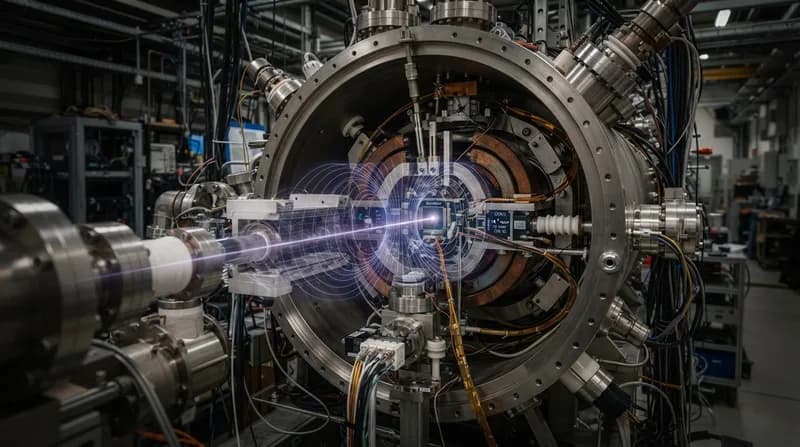
The research team utilized a single calcium ion as a high-precision probe, suspending it in a state of near-motionless suspension using an advanced ion trap. By moving this ion through different sectors of a tightly focused laser beam, the researchers were able to map out the exact strength of the light's interaction at various positions. The data revealed a startling deviation: the light does not interact most strongly at the beam's geometric center. Instead, due to the complex structure of the electromagnetic field under tight focusing, the strongest point of interaction is displaced slightly to the side.

Perhaps the most unexpected finding is that this displacement is entirely dependent on the wavelength of the light, rather than the tightness of the laser's focus. By experimentally confirming this, the team has successfully validated a theoretical prediction made years ago by researchers at the University of Amsterdam, transforming a abstract mathematical model into a measurable reality of quantum optics.

Implications for the Quantum Frontier

The implications of this "optical curveball" are two-fold, presenting both a hurdle and a potential opportunity for the quantum computing industry. Lasers are fundamental tools for manipulating the quantum states of qubits. If designers ignore the optical Magnus effect, the inherent sideways shift could introduce systematic errors into quantum gates, leading to a loss of the extreme precision required for large-scale, fault-tolerant computation. As developers strive to scale up quantum processors, accounting for this subtle displacement will likely become a mandatory calibration step.

However, the effect might also be harnessed as an innovative engineering tool. Because the shift generates specific forces, it could provide a novel mechanism for coupling qubits together, allowing for more intricate quantum gate operations. By intentionally utilizing these optical forces, researchers could potentially simplify the architecture of future quantum chips, opening new pathways for linking qubits without adding unnecessary physical complexity.

  • Discovery: Experimental confirmation of the optical Magnus effect at the atomic level.
  • Method: Using a single trapped calcium ion as a spatial probe for laser light.
  • The Shift: Laser-matter interaction peaks slightly off-center due to complex electromagnetic field structures in tightly focused beams.
  • Future Outlook: The effect is a potential source of error in quantum logic, but could be repurposed to facilitate qubit coupling.

The 5 Best Over-Ear ANC Headphones of 2026, Tested & Ranked
Editor's Pick Guide
92/100
Tech & Gadgets12 min read

The 5 Best Over-Ear ANC Headphones of 2026, Tested & Ranked

We locked five over-ear ANC picks for 2026 — Sony WH-1000XM6, Bose QuietComfort Ultra 2, Soundcore Space One, Sennheiser Momentum 5, and Apple AirPods Max 2 — then stress-tested them on lab metrics, long-term owner truth, and live street prices.

Related Stories

Semantically matched articles, ranked by topic overlap and freshness.

NASA's Roman Space Telescope Set for Two Decades of Cosmic Discovery
Science

NASA's Roman Space Telescope Set for Two Decades of Cosmic Discovery

Thanks to exceptional launch precision and significant fuel savings, the Nancy Grace Roman Space Telescope is poised to more than double its mission life, potentially operating for over 22 years.

Unlocking Predictive Markers: How B Cells Could Forecast Immunotherapy-Induced Colitis
Science

Unlocking Predictive Markers: How B Cells Could Forecast Immunotherapy-Induced Colitis

New research from MD Anderson Cancer Center suggests that B cell activity acts as a crucial early-warning system for identifying patients at risk of developing severe colitis during cancer treatment.

Could a Tiny Brain Protein Be the Master Switch for Aging?
Science

Could a Tiny Brain Protein Be the Master Switch for Aging?

Researchers have identified that declining levels of a brain protein called Menin may drive systemic aging, offering a potential new target for age-related health interventions.

Challenging Einstein: Scientists Pioneer Gravity Tests Using Exotic Muonium Atoms
Science

Challenging Einstein: Scientists Pioneer Gravity Tests Using Exotic Muonium Atoms

Researchers at ETH Zurich have developed a method to create controlled beams of muonium, potentially enabling the first-ever gravitational tests on second-generation particles.

Unlocking the Narrative: AI System Transforms Physician Notes into Actionable Medical Data
Science

Unlocking the Narrative: AI System Transforms Physician Notes into Actionable Medical Data

A groundbreaking study reveals how a new AI system can parse clinical prose at scale, converting hidden patient insights into verifiable, computer-readable data.

Caltech’s Femtosecond Breakthrough: Steering Light with Light
Science

Caltech’s Femtosecond Breakthrough: Steering Light with Light

Researchers have engineered a nanoscale silicon metasurface capable of redirecting light beams in just 74 quadrillionths of a second, shattering traditional speed barriers in photonic computing.

Beyond the Starch: Why Black and Green Rice Are Emerging as Metabolic Superfoods
Science

Beyond the Starch: Why Black and Green Rice Are Emerging as Metabolic Superfoods

New research from Hokkaido University reveals that pigmented rice varieties contain unique, beneficial fats that could revolutionize dietary approaches to blood sugar management.

Biological Breakthrough: Scientists 3D-Print a Functional Human Gut-on-a-Chip
Science

Biological Breakthrough: Scientists 3D-Print a Functional Human Gut-on-a-Chip

Researchers at Lawrence Livermore National Laboratory have successfully replicated the complex 3D architecture of the human small intestine on a compact, microfluidic device.