A New Blueprint for Efficiency
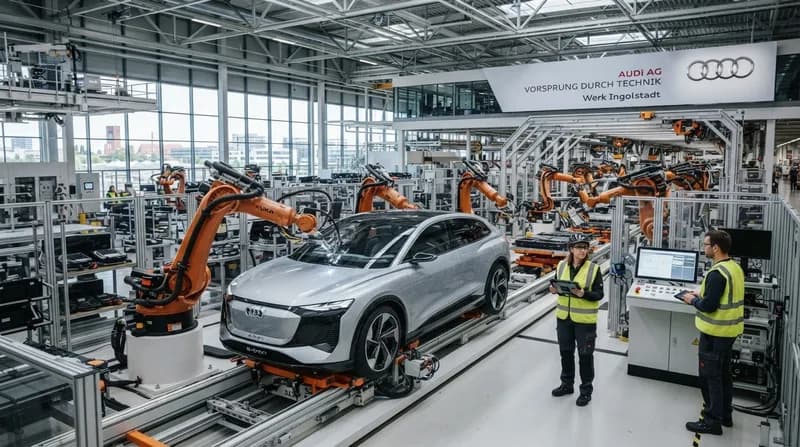
Audi has officially commenced production of the A2 e-tron at its primary plant in Ingolstadt, signaling a significant shift in how the German automaker approaches the development of battery-electric vehicles. By leveraging the Volkswagen Group’s updated Modular E-Drive Toolkit (MEB+), the company has successfully reduced the project's development timeline by 21 months compared to previous vehicle programs. This acceleration is not merely a product of haste; it is the result of streamlined internal processes, reduced coordination friction, and the clever reuse of existing manufacturing infrastructure.
The A2 e-tron, which hits the market with a starting price of €38,200, serves as a testbed for Audi's latest production philosophies. By minimizing the total number of unique parts and integrating manufacturing with the existing A3 line, Audi has effectively reduced logistics complexity. This consolidation means fewer 'logistics supermarkets' within the facility, freeing up valuable floor space and simplifying the supply chain for raw materials.
Advanced Robotics and the 'String of Pearls'
Central to this transformation is the adoption of the 'string of pearls' production principle. Already proven at the company’s Neckarsulm site, this method synchronizes customer orders six days before assembly begins. By maintaining a strict, fixed sequence across all manufacturing trades, Audi eliminates the need for massive storage zones and complex sequencing areas. This ensures that suppliers deliver parts in the exact order required, allowing for a seamless flow directly into the assembly line.
Audi is also pushing the boundaries of automation with the A2 e-tron. The factory has introduced fully robotic stations that replace traditional manual screw-fastening processes for axle pre-assembly. Perhaps most impressive is the integration of 'bin picking' technology. Using advanced image processing and camera-guided robotics, the system can identify and extract small sheet metal components from disorganized containers, feeding them directly into the production cycle without the need for pre-sorted parts.
Digital Infrastructure and AI Integration
The digitization of the factory floor is further enhanced by the 'Edge Cloud 4 Production' system. This industrial cloud serves as the central nervous system for assembly, managing vehicle control unit testing and bespoke customer configurations. By moving these functions to a cloud-based architecture, Audi has eliminated the need for over 450 individual industrial PCs, significantly reducing hardware overhead and potential points of failure.
Why it Matters
- Development Speed: A 21-month reduction in development time sets a new benchmark for Audi's agility in the competitive EV market.
- Cost-Effectiveness: By repurposing existing equipment—including over 1,200 manufacturing tools—and reducing part complexity, Audi is proving that profitable EV manufacturing remains viable in Germany.
- AI-Driven Workforce: The implementation of cross-site AI knowledge assistants, such as the Supply Chain Chatbot and Maintenance Chat, provides employees with immediate expert guidance, streamlining fault analysis and documentation tasks.
Ultimately, the A2 e-tron is more than just a new entry in the compact class; it is a proof-of-concept for a more agile, high-tech industrial future. With the combination of AI support, sophisticated robotics, and a highly synchronized supply chain, Audi is aiming to ensure that its domestic manufacturing remains both competitive and sustainable in an increasingly electrified landscape.